The Content Creator's DMCA Glossary: Every Copyright Term You Need to Know
You’ve probably seen the letters “DMCA” thrown around in creator forums, Discord servers, and Reddit threads. Usually right after someone discovers their content has been leaked to a piracy site. But when you actually try to understand what a “Section 512 safe harbor” or a “counter-notification” means, you hit a wall of legal jargon written for lawyers, not for the person whose OnlyFans content just showed up on some scraper site.
This DMCA glossary cuts through the legalese. Every term below is explained in plain language with context that actually matters to you as a content creator: what it means, why you should care, and how it connects to protecting (or recovering) your work. Think of it as a copyright glossary for creators, not for lawyers. Whether you’re filing your first DMCA takedown or trying to understand the new TAKE IT DOWN Act, bookmark this page. You’ll come back to it.
What is the DMCA and why should creators care?
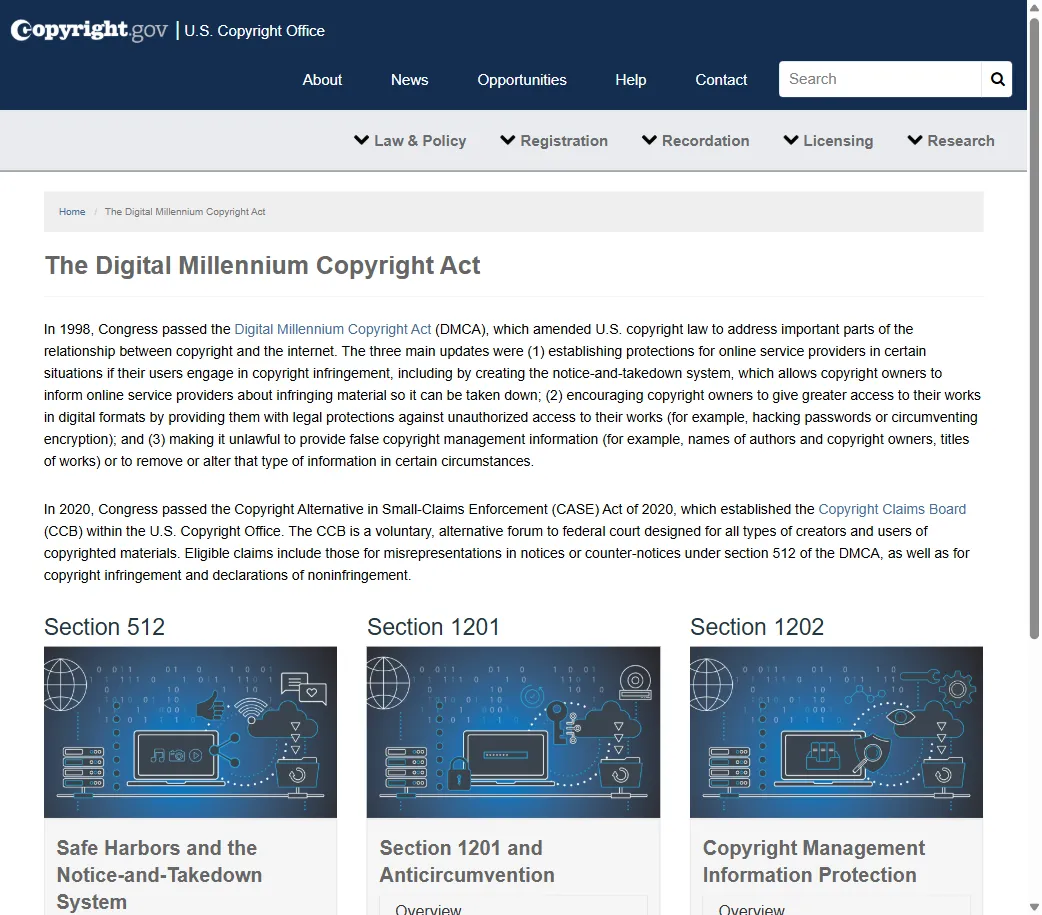
So, what is DMCA? The DMCA (Digital Millennium Copyright Act) is a U.S. federal law passed in 1998 that governs how copyright works on the internet. If you’ve ever filed a takedown request, you’ve used the DMCA.
The law has three main parts, and each one matters to creators for different reasons:
- Section 512 created the notice-and-takedown system. This is the part most people mean when they say “DMCA.” It lets you send a formal notice to a website or platform demanding they remove your stolen content.
- Section 1201 made it illegal to bypass DRM, paywalls, and other access controls. When someone cracks a paywall to scrape your content, that’s a Section 1201 violation on top of the copyright infringement itself.
- Section 1202 protects “copyright management information,” which includes watermarks, metadata, and author credits. Stripping your watermark before reposting? That’s a separate violation. (You can embed hidden watermarks with our invisible watermark tool or attach cryptographic proof of authorship with C2PA content credentials.)
Here’s what gets me about the DMCA: it was written in 1998, before YouTube, before OnlyFans, before social media existed in any recognizable form. And yet it’s still the primary tool creators use to fight content theft online. The law has real limitations (more on those below), but understanding how it works is step one for any creator dealing with leaks.
Core DMCA terms every creator should know
With the overview out of the way, let’s get into the specific DMCA terms explained one by one. These are the terms you’ll encounter the moment you try to get stolen content removed. They all come from Section 512 of the DMCA.
Takedown notice (DMCA notice)
A formal written request sent to a website, hosting provider, or search engine asking them to remove content that infringes your copyright. The notice must include specific elements to be valid: identification of the copyrighted work, the infringing URLs, your contact information, and a statement made “under penalty of perjury” that you’re authorized to act on behalf of the copyright owner.
Why creators care: This is your primary weapon against leaks. When your content shows up on a piracy site, a DMCA takedown notice is usually the fastest way to get it removed. You can generate one using our DMCA takedown template.
Counter-notice (counter-notification)
A formal response from someone who received a takedown notice, claiming the content was removed by mistake or was misidentified. If a platform receives a valid counter-notice, they must wait 10-14 business days and then restore the content unless the copyright holder files a lawsuit.
Why creators care: Counter-notices are relatively rare in piracy cases because the person filing one must provide their real name and address, and they’re swearing under penalty of perjury that the content isn’t infringing. Most pirates don’t want to identify themselves. But it does happen, and when it does, you need to understand the timeline. See our counter-notice guide for details.
Safe harbor
A legal protection for online service providers (platforms, hosts, search engines) that shields them from liability for their users’ copyright infringement, as long as they follow certain rules. Those rules include responding to valid takedown notices, not having “actual knowledge” of infringement, and maintaining a “repeat infringer policy.”
Why creators care: Safe harbor is the reason platforms actually respond to your takedown notices. Without it, they’d have no legal incentive to build reporting systems. It also means platforms aren’t liable for the infringement itself, only the person who uploaded your content is. So when a site ignores your DMCA notice, they risk losing their safe harbor protection, which is powerful leverage.
Designated agent
A person or entity that a platform officially registers with the U.S. Copyright Office to receive DMCA takedown notices. Every platform that wants safe harbor protection must have one.
Why creators care: If you’re sending a DMCA notice, you want to send it to the right place. Check the U.S. Copyright Office directory to find a platform’s designated agent.
Good faith belief
A legal standard that appears in both takedown notices and counter-notices. When you file a takedown, you must state that you have a “good faith belief” that the use of your material is not authorized. When someone files a counter-notice, they must state they have a “good faith belief” the material was removed by mistake.
Why creators care: This isn’t just a checkbox. Filing a takedown without a good faith belief can expose you to liability. That said, if your original content was posted without your permission, your good faith belief is straightforward.
Repeat infringer policy
A requirement under Section 512 that platforms must adopt and “reasonably implement” a policy of terminating accounts of users who repeatedly infringe copyright.
Why creators care: If someone keeps re-uploading your content after takedowns, you can point to this requirement when escalating with the platform. A platform that doesn’t terminate repeat infringers risks losing safe harbor.
Put-back / restoration
The process by which a platform restores content that was taken down, typically after receiving a valid counter-notice and waiting the required 10-14 business days without the copyright holder filing a lawsuit.
Why creators care: If your content gets restored after a counter-notice, your options narrow to filing a federal lawsuit. This is rare in piracy cases, but it’s good to know the full process.
The notice-and-takedown process, step by step
Understanding the flow helps you know what to expect and where things can stall.
Step 1: You discover the infringement. Your content appears on a site without your permission. Maybe you found it through a Google search, a fan told you, or you used a leak checking tool.
Step 2: You send a DMCA takedown notice. This goes to the website’s hosting provider, the site itself, or a search engine like Google. The notice must meet specific legal requirements (identification of works, infringing URLs, your contact info, a good faith statement, a perjury statement).
Step 3: The service provider reviews and acts. Under the DMCA, platforms must remove or disable access to the content “expeditiously” after receiving a valid notice. In practice, this ranges from a few hours to a few weeks depending on the platform.
Step 4: The uploader gets notified. The platform tells the person who posted the content that it’s been removed and provides them a copy of your notice (with your personal information, which is worth knowing).
Step 5: Counter-notice window. The uploader has the option to file a counter-notice. If they do, the platform must wait 10-14 business days and then restore the content, unless you file a lawsuit.
Step 6: Resolution. Either the content stays down (most common in piracy cases) or it gets restored after a counter-notice, at which point your option is litigation.
Copyright fundamentals in plain English
You don’t need a law degree to understand these. But if you’re going to fight for your content, knowing the basics helps.
Copyright
A legal right that automatically belongs to the creator of an original work the moment it’s “fixed in a tangible medium.” For digital creators, that means the moment you take a photo, record a video, or write a post. You don’t need to register it. You don’t need a copyright symbol. It’s yours.
Why creators care: Every piece of original content you create is copyrighted the instant you create it. That’s the legal basis for every takedown you file.
Copyright infringement
Using, reproducing, or distributing someone’s copyrighted work without permission. Reposting a creator’s OnlyFans content on a piracy site is copyright infringement, full stop.
Why creators care: This is the legal term for what happens when your content gets leaked. It’s a federal offense in the U.S., and the penalties can be significant. Whether it’s your OnlyFans sets on a piracy forum or your TikTok videos reposted without credit, it’s all copyright infringement.
Copyright registration
A formal process of registering your work with the U.S. Copyright Office. Registration is not required for copyright to exist, but it unlocks additional legal benefits: you can file a federal lawsuit, and you may be eligible for statutory damages and attorney’s fees.
Why creators care: For most creators, registration makes sense for your most valuable content. It costs $65 for a single work through the Copyright Office’s online system. But you can file DMCA takedowns without it.
Fair use
A legal doctrine that allows limited use of copyrighted material without permission for purposes like criticism, commentary, news reporting, teaching, and parody. Fair use is determined by four factors: the purpose of the use, the nature of the copyrighted work, how much was used, and the effect on the market.
Why creators care: People who repost your content sometimes claim “fair use” as a defense. In the vast majority of piracy cases, this doesn’t hold up. Reposting someone’s entire OnlyFans set with no commentary or criticism is not fair use. Period. But fair use claims do appear in counter-notices, so understanding the doctrine helps you respond.
Public domain
Works not protected by copyright, either because the copyright expired, the creator waived it, or the work was never eligible. Public domain works can be used by anyone for any purpose.
Why creators care: Your original content is NOT in the public domain just because you posted it online. Posting on a platform grants that platform a license (per their terms of service), but it doesn’t put your work into the public domain.
Derivative work
A new work based on one or more existing copyrighted works, like a remix, translation, adaptation, or edited version. Only the copyright holder can authorize derivative works.
Why creators care: If someone edits, crops, or remixes your content and reposts it, that’s a derivative work created without your authorization. It’s still infringement.
Need stolen content removed?
Anti-circumvention and content protection technology
These content protection terms deal with the technical side of keeping your work secure. Section 1201 and 1202 of the DMCA cover this territory.
DRM (digital rights management)
Technology that controls access to digital content. On creator platforms, this includes things like preventing screenshots, blocking screen recording, and encrypting video streams. OnlyFans, Fansly, and Patreon all use some form of DRM.
Why creators care: DRM is your first line of defense. It won’t stop determined pirates, but it raises the barrier. And when someone bypasses DRM to steal your content, they’ve committed a separate legal violation under Section 1201 beyond the copyright infringement itself. Course creators on Skool face this constantly with content scrapers.
Anti-circumvention (Section 1201)
The DMCA provision that makes it illegal to bypass “effective technological measures” that control access to copyrighted works. This covers cracking paywalls, defeating encryption, or using tools to bypass DRM on creator platforms.
Why creators care: This gives you an additional legal claim when someone scrapes content from behind your paywall. The person didn’t just infringe your copyright; they also violated Section 1201, which carries its own penalties.
Copyright management information (Section 1202)
Information conveyed in connection with a copyrighted work that identifies the work, the author, or the copyright owner. This includes watermarks, embedded metadata, author credits, and terms of use. Section 1202 of the DMCA makes it illegal to remove or alter this information with intent to facilitate infringement.
Why creators care: When someone strips your watermark before reposting your content, that’s a Section 1202 violation. It’s a separate claim you can pursue alongside the infringement itself.
Watermarking / fingerprinting
Techniques for embedding identifying information into content. Visible watermarks are text or logos overlaid on images or video. Digital fingerprinting creates a unique identifier based on the content itself (like a hash) that can be used to detect copies even if the file has been modified.
Why creators care: Watermarks serve two purposes: deterrence (making stolen content less valuable) and identification (proving the content is yours). Fingerprinting is what tools like Content ID and StopNCII use to detect your content automatically.
Content ID
YouTube’s automated copyright detection system that scans uploaded videos against a database of reference files provided by copyright owners. When a match is found, the copyright owner can choose to block, monetize, or track the video.
Why creators care: If your content ends up on YouTube, Content ID can catch it automatically. But you need to have reference files in the system, which typically requires working with a content management partner or a service like CopyrightShark. Stolen TikTok videos reuploaded to YouTube are a common case where Content ID helps. See our TikTok content protection guide for more on cross-platform theft.
Hash matching
A technique where a unique digital “fingerprint” (hash) is generated from a piece of content. This hash can be compared against other content to find exact or near-exact copies. StopNCII and PhotoDNA use this approach.
Why creators care: Hash matching is the technology behind “stay-down” systems, where platforms automatically detect and block re-uploads of content that’s already been removed. If you’re dealing with re-uploads on platforms that scrape content automatically (like Kemono), hash-based detection is one of the few tools that can keep up.
NCII and intimate image protection terms
These terms matter specifically for creators whose intimate or sexual content gets leaked without consent. The legal framework here overlaps with copyright but also includes separate protections.
NCII (non-consensual intimate images)
Images or videos of a sexual or intimate nature that are shared without the depicted person’s consent. This is the legal and academic term for what’s commonly called “revenge porn,” though the term applies regardless of the sharer’s motive.
Why creators care: If your intimate content from OnlyFans, Fansly, or similar platforms gets leaked, NCII laws give you removal options that go beyond copyright claims. Many platforms have specific NCII reporting channels that are faster than standard DMCA processes.
Revenge porn
An older, colloquial term for NCII. Most legal and advocacy organizations now prefer “NCII” or “non-consensual intimate images” because “revenge” implies a motive that isn’t always present. Content can be shared without consent for profit, status, harassment, or no particular reason at all.
Why creators care: You’ll still see this term everywhere in state laws and platform policies. Just know that “NCII” is the more accurate term, and it covers a wider range of situations.
Deepfake
AI-generated or AI-manipulated media that depicts a person doing or saying something they never actually did. In the context of NCII, deepfake intimate images are a growing problem, with AI tools making it increasingly easy to create fake explicit content using someone’s face.
Why creators care: Even if you’ve never created explicit content, your face could be used to generate deepfake NCII. The TAKE IT DOWN Act specifically covers this scenario.
U.S. laws and frameworks beyond the DMCA
The DMCA isn’t the only U.S. law that matters for content protection. These newer laws expand what’s possible.
TAKE IT DOWN Act (2025)
A U.S. federal law signed in May 2025 that makes it a federal crime to publish NCII, including AI-generated deepfakes. The law requires platforms to remove reported NCII within 48 hours and establishes criminal penalties of up to 2 years in prison for publishing non-consensual intimate images.
Why creators care: This is a game-changer for intimate content creators. Unlike the DMCA (which is about copyright), the TAKE IT DOWN Act is about consent. You don’t need to prove you own the copyright; you just need to prove the images are intimate and were shared without your consent. Platforms must comply within 48 hours, which is much faster than most DMCA timelines. Read our full breakdown in the TAKE IT DOWN Act guide for creators.
Statutory damages
A fixed range of monetary damages that courts can award in copyright infringement cases, even if the copyright holder can’t prove actual financial losses. Under U.S. law, statutory damages range from $750 to $30,000 per work infringed, and up to $150,000 per work for willful infringement.
Why creators care: This is why copyright registration matters. Statutory damages are only available if you registered your work before the infringement began (or within 3 months of publication). Without registration, you can only recover actual damages, which are harder to prove.
DMCA subpoena
A legal mechanism under Section 512(h) of the DMCA that allows a copyright holder to request a federal court to order a service provider to identify an anonymous infringer. The subpoena can compel the provider to hand over the infringer’s name, address, and other identifying information.
Why creators care: If someone is repeatedly leaking your content anonymously, a DMCA subpoena can help you identify them. It’s faster and cheaper than full litigation, though it still requires filing with a federal court.
Copyright Claims Board (CCB)
A tribunal within the U.S. Copyright Office created by the CASE Act of 2020. The CCB handles small copyright claims (up to $30,000) without the expense and complexity of federal court.
Why creators care: If you have a copyright dispute that’s too small to justify hiring a federal lawyer but too important to ignore, the CCB is an option. Both parties must agree to participate (the respondent can opt out), but when it works, it’s much faster and cheaper than court.
International content protection laws
The DMCA is a U.S. law, but content leaks are a global problem. These international frameworks matter if your content appears on sites outside the United States or if you’re based outside the U.S. yourself.
Digital Services Act (DSA)
An EU regulation (effective February 2024) that sets rules for how online platforms handle illegal content, including copyright-infringing material. The DSA replaced the older E-Commerce Directive’s liability framework and introduced standardized “notice and action” procedures, transparency requirements, and obligations for very large platforms.
Why creators care: If your content appears on an EU-based platform or a large platform operating in the EU, the DSA gives you a formal process to report it. Platforms must acknowledge your report and explain their decision, which is an improvement over the old system where reports sometimes vanished into the void.
GDPR (right to erasure)
The EU’s General Data Protection Regulation gives individuals the right to request deletion of their personal data under certain conditions. If leaked content identifies you (common for intimate content), GDPR erasure requests can supplement copyright-based removal efforts with EU-based services.
Why creators care: GDPR erasure is a separate legal tool from DMCA takedowns. It works especially well when copyright claims are complicated (e.g., if someone else holds the copyright) but your personal data is still being processed without a lawful basis.
Right to be forgotten
A concept from EU case law (Google Spain v. AEPD, 2014) that allows individuals to request search engines to delist URLs containing personal information that is “inadequate, irrelevant, or no longer relevant.” Now partially codified in GDPR Article 17.
Why creators care: Even if a piracy site ignores your takedown requests, you can ask Google to delist those pages from EU search results. It doesn’t remove the content, but it makes it much harder to find.
E-Commerce Directive
An older EU directive (2000) that established the original “safe harbor” framework for hosting providers in the EU. Largely superseded by the DSA for content moderation issues, but its principles still inform how EU hosts handle takedown requests.
DSM Copyright Directive (Article 17)
The EU’s 2019 directive that shifted some copyright responsibility onto platforms. Article 17 requires certain large platforms to make “best efforts” to obtain authorization from rights holders and to prevent re-uploads of content that’s been taken down.
Why creators care: This is the EU’s answer to the “whac-a-mole” problem. Instead of filing takedowns every time your content gets re-uploaded, Article 17 puts some of that burden on the platform. In practice, implementation varies widely between member states.
InfoSoc Directive
The EU’s 2001 directive on copyright in the information society, which includes anti-circumvention protections similar to the DMCA’s Section 1201. Member states must provide legal protection against bypassing DRM and removing watermarks or metadata.
UK Online Safety Act (Section 188)
UK legislation (in force since January 2024) that replaced the older “revenge porn” offence. Section 188 criminalizes sharing or threatening to share intimate photographs or films without consent. Unlike the older law, it doesn’t require proving intent to cause distress.
Why creators care: If you have a UK connection (based there, or the perpetrator is), this law gives you criminal law leverage that can speed up platform cooperation considerably.
Google deindexing and search removal terms
Even when content can’t be removed from a site, you can make it invisible in search results.
Deindexing / delisting
The process of removing a URL from a search engine’s index so it no longer appears in search results. The content still exists at the original URL, but people can’t find it through Google, Bing, or other search engines.
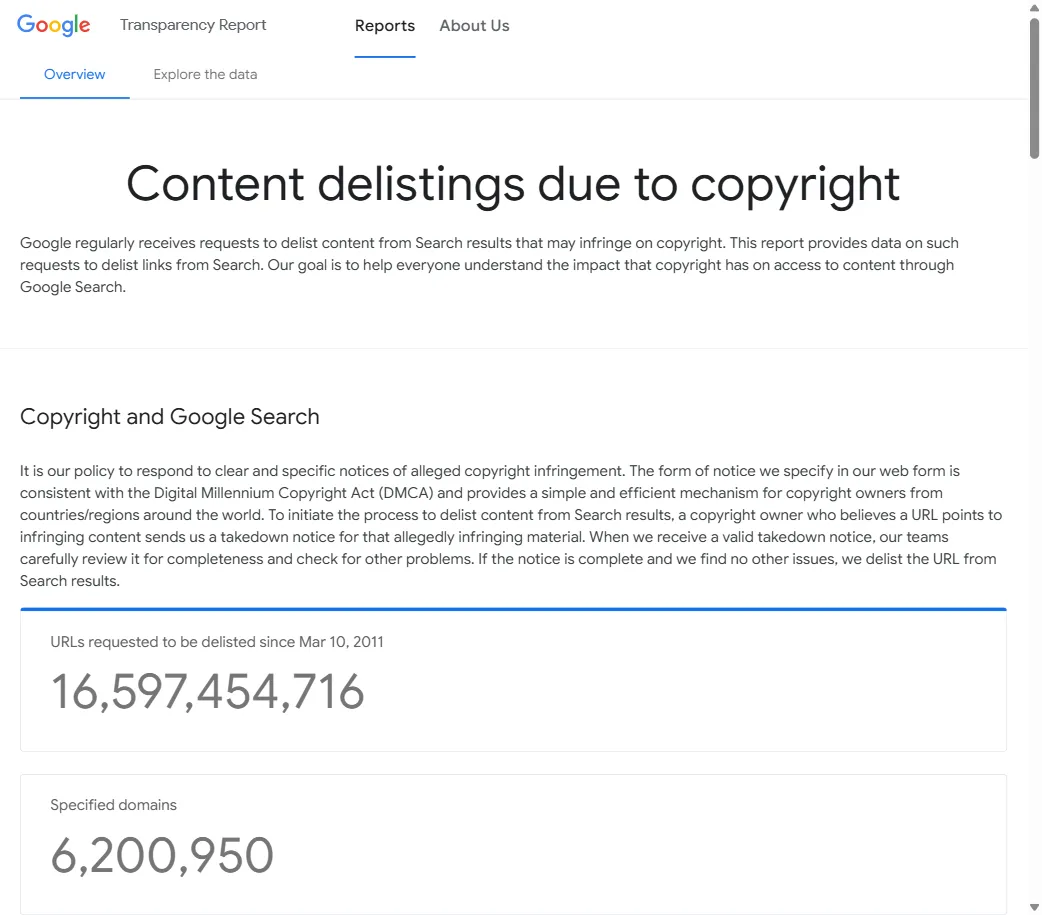
Why creators care: Deindexing is often your most practical option when a piracy site ignores takedown requests. Most people find leaked content through search engines, so removing those search results cuts off the primary traffic source. Google has processed over 16.5 billion copyright-related delisting requests since 2011.
Google Transparency Report
A public dashboard where Google publishes data on content removal requests, including copyright-related delistings. You can search by domain, copyright owner, or reporting organization.
Why creators care: The Transparency Report lets you see how many takedown requests have been filed against specific piracy sites, which can help you understand how responsive Google is to requests targeting that domain.
DMCA delisting request (Google)
The specific process of asking Google to remove URLs from search results based on copyright infringement. Google provides a web form for submitting these requests, and they typically process them within 1-7 days.
Why creators care: Even if a piracy site ignores your takedown notice, you can separately ask Google to delist the infringing URLs from search. This is one of the most effective steps you can take because it cuts off discoverability.
Organizations and tools you should know
These organizations and services play specific roles in content protection that creators should be aware of.
StopNCII
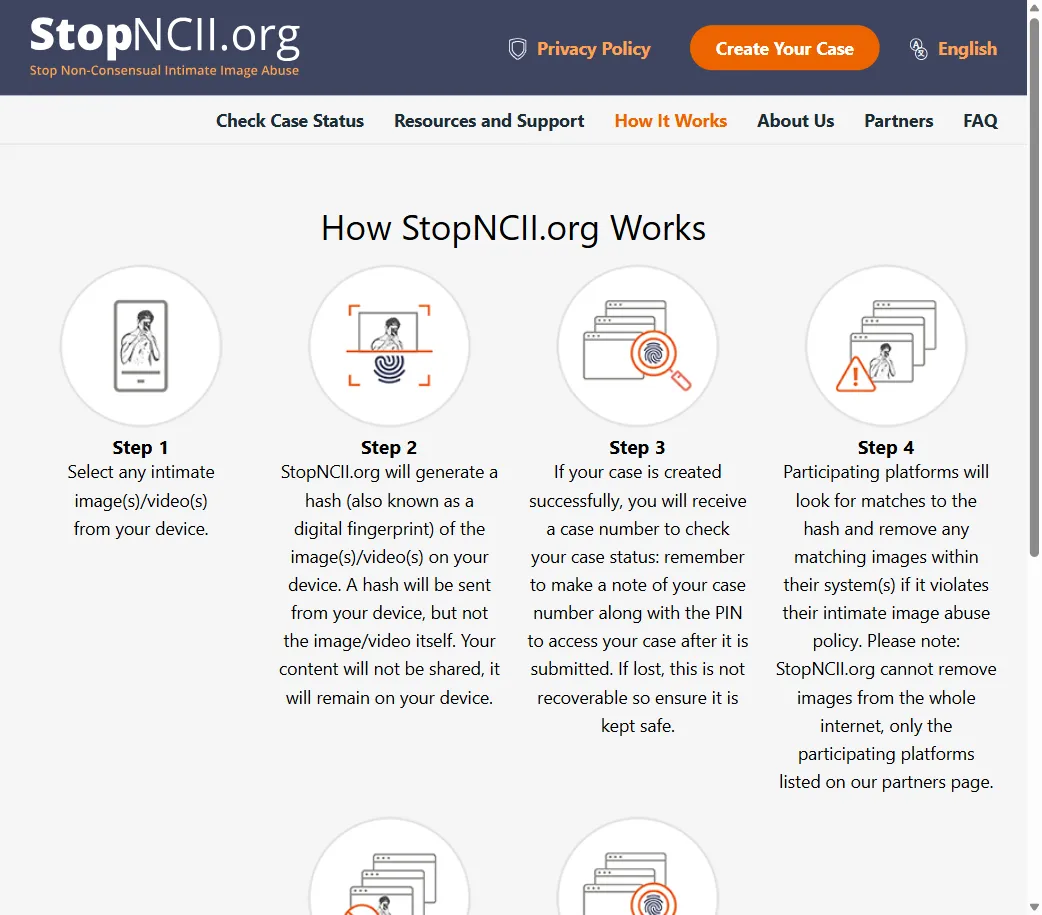
A free tool operated by the Revenge Porn Helpline (South West Grid for Learning) that helps prevent intimate images from being shared on participating platforms. You select images on your device, StopNCII generates a hash (digital fingerprint) without uploading the actual image, and participating platforms like Meta and TikTok use these hashes to detect and remove matching content.
Why creators care: StopNCII is one of the best “stay-down” tools available for NCII. Once you create a case, participating platforms continuously scan for your content. The limitation is that it only works on participating platforms. See our OnlyFans content protection guide for more options.
CCRI (Cyber Civil Rights Initiative)
A nonprofit organization that supports victims of online abuse, including NCII. CCRI operates a helpline (1-844-878-CCRI), provides platform-by-platform removal guides, and advocates for stronger NCII legislation.
Why creators care: If you’re dealing with intimate image abuse and don’t know where to start, CCRI’s safety center has step-by-step reporting instructions for every major platform.
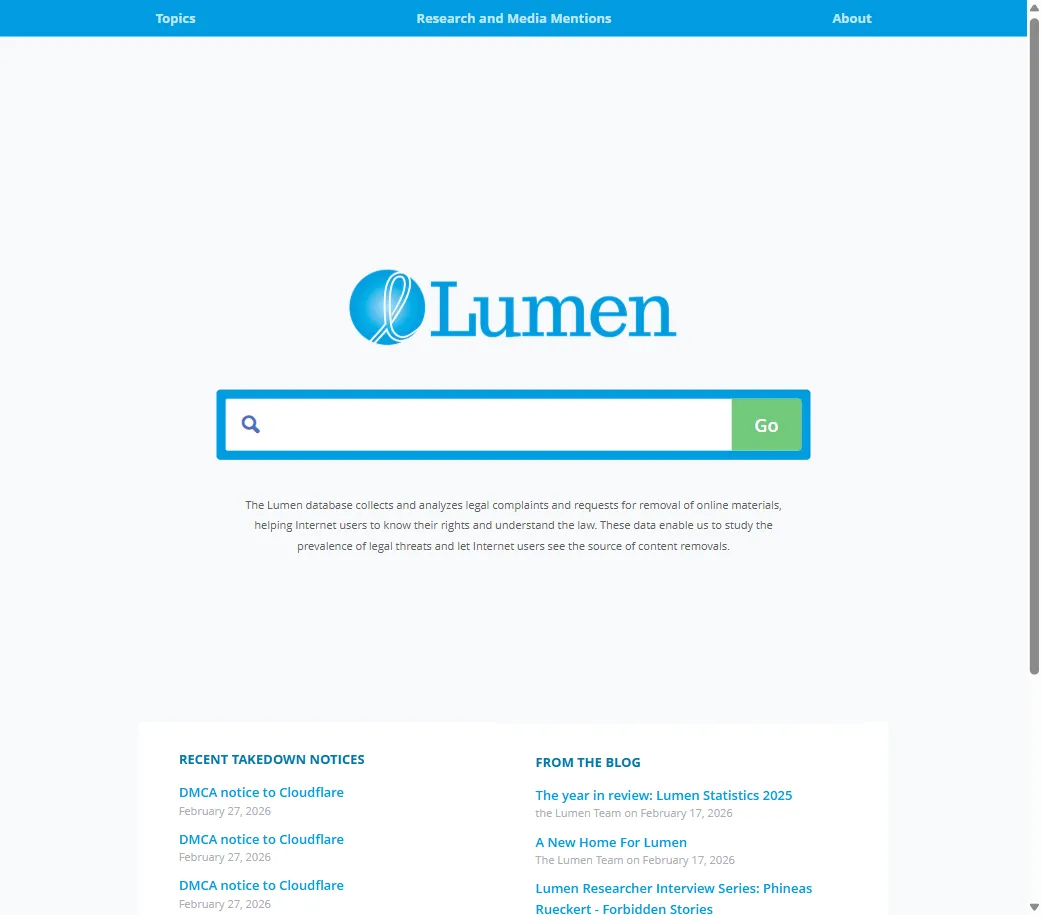
Lumen Database
A public archive of legal requests to remove online material, including DMCA takedown notices. Originally called “Chilling Effects Clearinghouse,” Lumen is run by the Berkman Klein Center at Harvard Law School. When Google processes a DMCA delisting request, they often send a copy of the notice to Lumen, where it becomes publicly searchable.
Why creators care: This is something many creators don’t realize: when you file a DMCA takedown with Google, your notice (including your name and the infringing URLs) may become publicly visible on Lumen. This transparency serves an important purpose (preventing abuse of the takedown system), but it means your name and the URLs you’re targeting can be found by anyone searching Lumen. Some creators use agent services to file on their behalf, keeping their personal information out of the public database.
WIPO (World Intellectual Property Organization)
A United Nations agency that administers international intellectual property treaties, including the WIPO Copyright Treaty (1996) that the DMCA was partly designed to implement. WIPO also operates a domain name dispute resolution service.
Why creators care: If someone registers a domain name using your brand or creator name to host pirated content, WIPO’s dispute resolution process can help you get that domain transferred or canceled.
U.S. Copyright Office
The federal agency that administers copyright registration, maintains the designated agent directory, and provides guidance on copyright law. Based in the Library of Congress.
Why creators care: This is where you register copyrights, look up designated agents for DMCA notices, and find official guidance on copyright questions.
Licensing
A formal arrangement where a copyright holder grants specific usage rights to another party, usually in exchange for compensation. When you post on OnlyFans or Fansly, you grant the platform a license (per their terms of service) to host and display your content. You do not transfer your copyright.
Why creators care: Understanding licensing helps you see the difference between authorized platform use and unauthorized piracy. Your platform’s license doesn’t extend to random third parties reposting your work elsewhere.
Dealing with leaked content right now?
Operational terms (what platforms and providers call things)
The last section of this DMCA glossary covers the operational language platforms use internally. Knowing these content protection terms helps you communicate more effectively when dealing with hosting providers and platform trust-and-safety teams.
Online service provider (OSP)
The DMCA’s term for any entity that provides online services, including hosting providers, search engines, ISPs, and platforms. The law defines four categories of OSPs, each with different safe harbor requirements.
Hosting provider
A company that provides server space for websites. When a piracy site is hosted by a third-party provider (as most are), you can send DMCA notices directly to the host, who can take down the entire site or specific content.
Why creators care: Many piracy sites themselves ignore DMCA notices. But their hosting providers often respond, because the host wants to maintain its own safe harbor protection.
Notice and action (EU variant)
The EU’s equivalent of the DMCA’s notice-and-takedown system, formalized under the Digital Services Act. The DSA requires platforms to process notices about illegal content and take action where appropriate, with specific transparency and reporting requirements.
Expeditious removal
The DMCA standard for how quickly a platform must act after receiving a valid takedown notice. The law says “expeditiously” without defining a specific timeframe, which has led to wildly inconsistent response times across platforms.
Why creators care: “Expeditiously” is intentionally vague. Some platforms remove content within hours. Others take weeks. When a platform drags its feet, you can argue they’re not meeting the “expeditious” standard and risk losing safe harbor protection.
Red flag knowledge
A legal concept under the DMCA where a service provider is aware of “facts or circumstances from which infringing activity is apparent.” If a platform has red flag knowledge and doesn’t act, it can lose safe harbor protection even without a formal takedown notice.
Why creators care: If a platform’s entire purpose is hosting pirated content (think: sites like SimpCity or Coomer), there’s a strong argument they have “red flag knowledge” of infringement. This can be useful in legal proceedings.
Actual knowledge
A higher standard than red flag knowledge. “Actual knowledge” means the service provider knows specific content is infringing. Receipt of a valid DMCA takedown notice creates actual knowledge.
DMCA agent
See “Designated agent” above. Same concept, different name. Platforms sometimes use “DMCA agent” informally to refer to their designated agent.
How to use this DMCA glossary when your content gets leaked
Knowing the terms is one thing. Knowing which ones matter in your specific situation is another. Here’s a quick decision framework:
If your content appears on a website:
- Send a DMCA takedown notice to the site and their hosting provider
- File a DMCA delisting request with Google to remove the URLs from search results
- If the site is in the EU, file a notice and action report under the DSA
If your intimate content was shared without consent:
- Report through the platform’s NCII reporting channel (faster than DMCA for intimate content)
- Create a case on StopNCII to prevent re-uploads on participating platforms
- If the platform is U.S.-based, cite the TAKE IT DOWN Act and its 48-hour removal requirement
- File a DMCA takedown as a parallel track (copyright + NCII = maximum pressure)
If you’re based in the EU or targeting EU sites:
- Use GDPR erasure requests alongside DMCA takedowns
- File DSA complaints with platforms that have EU obligations
- Request deindexing from Google under the right to be forgotten
If you want to prevent future leaks:
- Enable DRM settings on your platform (OnlyFans, Fansly, Patreon all have options)
- Use visible watermarks on your content
- Register your most valuable works with the U.S. Copyright Office for statutory damages eligibility
- Consider a content protection service for ongoing monitoring and automated removal
Frequently asked questions
- What does DMCA stand for?
- DMCA stands for Digital Millennium Copyright Act, a U.S. federal law passed in 1998. It establishes rules for copyright on the internet, including the notice-and-takedown system that lets copyright owners request removal of infringing content from websites and search engines.
- What is the difference between a DMCA takedown and a counter-notice?
- A DMCA takedown is a request from a copyright owner to remove infringing content. A counter-notice is a response from the person whose content was removed, claiming the takedown was a mistake. After a valid counter-notice, the platform must restore the content in 10-14 business days unless the copyright holder files a lawsuit.
- Does the DMCA apply outside the United States?
- The DMCA is a U.S. law, so it technically only applies to U.S.-based services. However, most major platforms (including those based outside the U.S.) accept DMCA-style takedown requests because they follow similar international standards. For EU-based sites, the Digital Services Act (DSA) provides a comparable notice-and-action framework.
- What is fair use and does it protect content reposters?
- Fair use allows limited use of copyrighted material for purposes like criticism, commentary, and parody. Reposting someone's entire content without adding commentary or transformative value is almost never fair use. Pirates sometimes claim fair use in counter-notices, but this defense rarely holds up for straightforward content theft.
- How long does a DMCA takedown take?
- Response times vary by platform. Google typically processes delisting requests within 1-7 days. Social media platforms often act within 24-72 hours. Hosting providers range from same-day to several weeks. Piracy-focused sites may ignore notices entirely, which is when professional removal services or hosting provider escalation becomes necessary.
- What is the TAKE IT DOWN Act and how does it affect creators?
- The TAKE IT DOWN Act is a U.S. federal law signed in 2025 that criminalizes publishing non-consensual intimate images, including AI-generated deepfakes. It requires platforms to remove reported NCII within 48 hours. Unlike the DMCA, it doesn't require copyright ownership, only proof that intimate content was shared without consent. We cover it in depth in our TAKE IT DOWN Act guide.
- What is NCII and how is it different from copyright infringement?
- NCII (non-consensual intimate images) refers to intimate or sexual content shared without the depicted person's consent. Copyright infringement is about unauthorized use of copyrighted work. They often overlap (leaked OnlyFans content is both), but NCII laws provide separate protections that don't require copyright ownership.
- Can I file a DMCA takedown if I don't have a copyright registration?
- Yes. Copyright exists automatically when you create an original work. You don't need to register with the U.S. Copyright Office to file a DMCA takedown. Registration does unlock additional legal benefits like statutory damages and the ability to file federal lawsuits, but it's not required for takedown notices.