Unlimited DMCA Removals: No Caps, No Per-Notice Fees

Finding out your content has been leaked across dozens of sites is stressful enough. Discovering that your DMCA takedown service caps you at ten links per day, or charges $199 per notice, makes it worse. That’s why unlimited DMCA removals matter: they’re the difference between a flat subscription and an unpredictable expense. Most “best DMCA takedown service” comparison articles gloss over this detail. Some services limit how many takedowns you can file per day or month, while others charge per notice with no ceiling in sight. For creators dealing with mass leaks across forums, file-sharing sites, and social media, those caps quietly eat into your budget.
This guide breaks down what unlimited DMCA removals actually means, which services impose caps, and why this overlooked detail should be the first thing you check when choosing a content removal service.
Why removal caps are the first thing to check
Every comparison article about DMCA takedown services talks about price, platform coverage, and turnaround time. Almost none mention removal caps. That’s a problem, because caps determine how much protection you actually get for your money.
In practice, caps take a few forms:
- Daily limits: You can submit 10 takedown requests per day. Got 80 leaked links? That’s 8 days of waiting while your content circulates.
- Monthly limits: Your plan allows 300 removals per month. Sounds generous until an agency splits that across 20 creators (15 each).
- Per-notice fees: No cap per se, but every single takedown costs $100-$199. A mass scrape event with 200 links could run you $20,000+.
Caps exist because managed takedowns cost money to execute. Someone (or some system) has to draft the notice, identify the right contact, submit it through the correct channel, and follow up. Services that charge less often cap volume to keep their margins workable. That makes business sense for them. It just doesn’t make sense for you when you’re dealing with a leak that hits 50 sites overnight.
When you’re comparing DMCA removal service pricing, the monthly subscription number is only half the picture. The other half is how many removals that number actually buys you.
What “unlimited DMCA removals” actually means
The word “unlimited” does a lot of heavy lifting in this industry. Not all uses of it mean the same thing.
DIY “unlimited” vs. managed unlimited: Some services offer “unlimited” access to self-service tools. You get a template, a database of hosting contacts, and the ability to send as many notices as you can manually draft. The service itself isn’t doing the work. DMCA.com, for example, offers what they call unlimited DIY tools, but their managed takedown service starts at $199 per notice.
Hidden sub-limits: A service might say “unlimited removals” but cap the number of URLs you can include per domain, or charge extra for search engine deindexing on top of source removal. Read the fine print.
Tiered “unlimited”: This is what CopyrightShark does, but the tiers don’t gate volume. Every paid plan gets unlimited removals. The tiers control where those removals happen: which platforms and categories of leak sites are covered. Standard covers core leak sites and forums. Plus adds social media and messenger apps. Premium adds dark web, P2P networks, and impersonation protection. The number of removals you can request? Uncapped on all of them.
The difference matters. When a service says “unlimited on our top tier,” they’re often saying the lower tiers have limits. When CopyrightShark says unlimited, it means every paying customer gets unlimited removals regardless of which plan they’re on.
How removal caps fail creators during mass leaks
Abstract cap numbers don’t mean much until you run the math on a real scenario. Here are three.
Scenario 1: Solo creator, 50 leaked files
You find your content on a leak forum, a tube site, two file-sharing platforms, and several social media reposts. That’s roughly 50 URLs to take down. With a 10-per-day cap, you’re looking at 5 days minimum. During those 5 days, each leaked file gets scraped, re-uploaded, and shared further. By the time you’ve cleared the first batch, a second wave has started.
Scenario 2: Agency managing 20 creators, 300/month cap
An agency on a plan with 300 monthly removals has to allocate about 15 removals per creator per month. That’s not enough for any creator who’s actively being leaked. One creator with a bad month could burn through half the agency’s quota, leaving the other 19 exposed.
Scenario 3: Per-notice pricing, 200+ links
A mass scrape event dumps 200+ links across various hosting services. At $199 per takedown notice, that’s $39,800. Most creators don’t have that budget. Most agencies don’t either. So the links stay up, traffic builds, and the content spreads to more sites.
Unlimited DMCA removals aren’t a nice-to-have. For any creator or agency dealing with leaks regularly, they’re the baseline.
Stop worrying about removal limits
DMCA takedown service comparison: removal limits breakdown
Most “best DMCA takedown service” roundups skip this part: a factual comparison of removal caps and what it actually costs to get unlimited volume.
| Service | Plan | Price | Removal cap | Cost for unlimited |
|---|---|---|---|---|
| Rulta | Pro | $109/mo | 10 requests/day | Legend tier at $324/mo |
| Ceartas | Star | $69/mo | 300/month | Elite tier at $169/mo |
| DMCA.com | Per-notice | $199/takedown | Per-notice (always) | N/A (always per-notice) |
| CopyrightShark | Standard | $59.99/mo | Unlimited | All tiers |
A few things to note about this comparison:
Rulta gates unlimited removals behind their highest tier at $324/month. Their mid-tier Pro plan caps you at 10 requests per day. For a single creator, 10/day might be sufficient during quiet periods. During a mass leak, it’s not.
Ceartas has a 300/month cap on their Star tier. Their Elite tier at $169/month removes that cap. For agencies, this pricing can add up fast when multiplied across creators.
DMCA.com doesn’t do subscriptions for managed removals. Every takedown is a separate billable event at $199+. Their “unlimited” marketing refers to their DIY toolkit, not to someone actually handling your takedowns.
In general, when evaluating dmca services, look at what “removal” means in their context. Does it include source-level takedowns, or only search engine deindexing? Does it include follow-up on rejected notices?
No single service is objectively “the best.” But removal caps and pricing structures vary wildly, and most dmca removal service comparison articles don’t tell you this.
Beyond caps: what else matters in a DMCA takedown service
Unlimited removals solve the volume problem. But volume alone doesn’t make a good DMCA takedown service. Here’s what else to look for:
Source removal + search engine deindexing
These are two different things and you need both. Source removal gets the actual content taken down from the hosting site. Search engine deindexing removes the URL from Google and Bing results. Some services only do one or the other. If you only deindex, the content is still live and accessible via direct links. If you only remove the source, cached versions and search snippets can linger for weeks.
CopyrightShark does both on every plan. Check our full feature breakdown for details on what each tier covers.
Anonymous submissions
This one matters more than people realize. Standard DMCA notices require identifying information: your name, address, and a statement under penalty of perjury. That information often ends up in public databases like the Lumen archive. For creators who keep their real identity private, this is a dealbreaker.
CopyrightShark files takedowns on your behalf using their own details. You don’t need to provide ID or personal information when submitting reports. Your identity stays out of public DMCA records entirely.
Evidence uploads
When you find leaked content, you should be able to attach screenshots, URLs, and additional context directly to your report. This speeds up the takedown process and gives the removal team what they need without back-and-forth emails.
Transparent reporting
You shouldn’t have to guess whether your takedowns are actually being processed. A reporting dashboard that shows every submitted link, its current status, and the outcome of each removal attempt is the minimum standard for accountability.
Platform coverage breadth
CopyrightShark’s tier system works differently. The tiers don’t limit how many removals you get. They determine the scope of platforms covered:
- Standard ($59.99/mo yearly): Core leak sites, forums, tube sites, file-sharing platforms, plus search engine removals
- Plus ($89.99/mo yearly): Everything in Standard + social media, messenger apps, deepfake protection
- Premium ($149.99/mo yearly): Everything in Plus + dark web scanning, P2P networks, impersonation protection, priority support
You pick the coverage level that matches your risk profile. The removal volume is unlimited regardless.
How CopyrightShark handles unlimited DMCA removals
Walk through the actual workflow.
Submitting a report
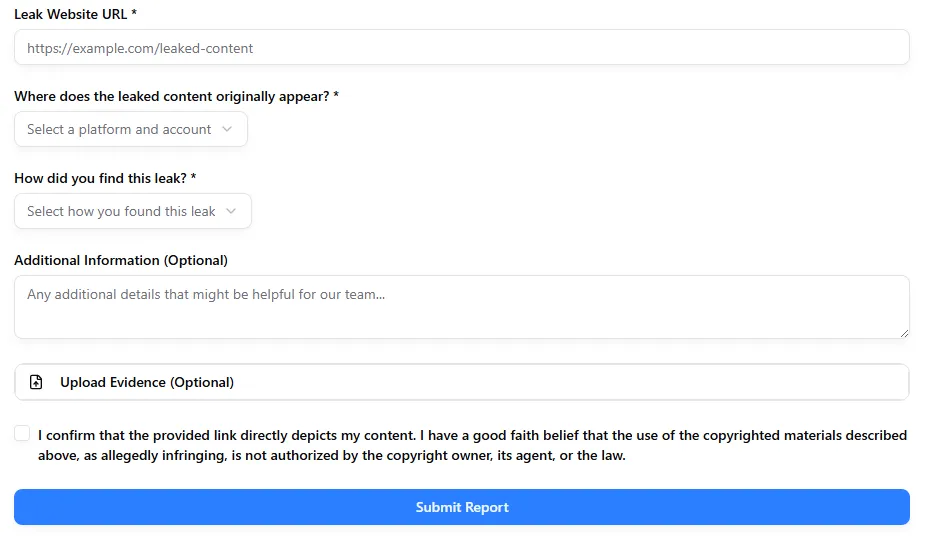
You log into the dashboard and submit either a leak report or an impersonation report. Each report lets you include URLs, descriptions, and evidence files. You don’t need to provide your real name or government ID. The submission is anonymous by default.
What happens next
The system combines automated scanning with human review. Automated scanners continuously monitor covered platforms for new instances of your content. When they find matches (or when you submit links manually), the removal process kicks off: DMCA notices get drafted, sent to the appropriate contacts, and tracked through resolution.
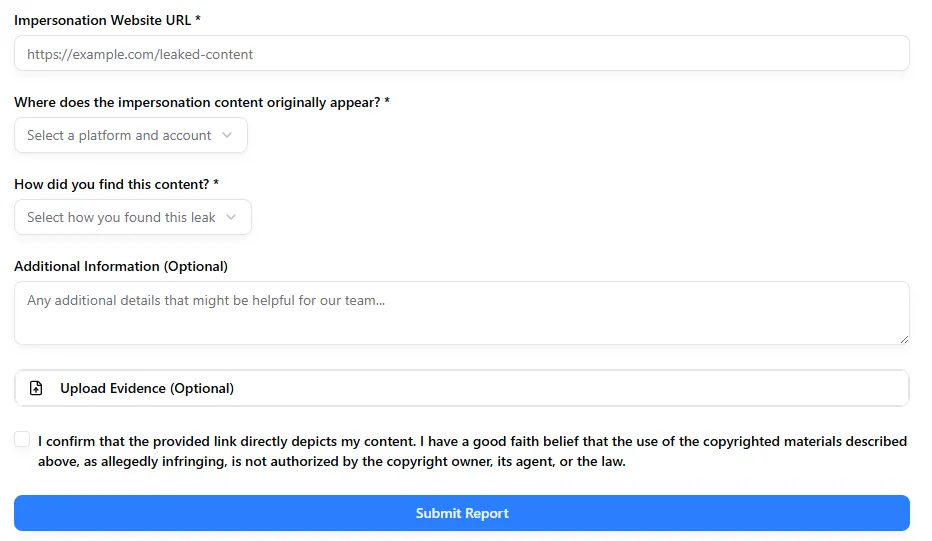
There’s no daily queue. There’s no “you’ve used your 10 for today, come back tomorrow.” If 50 links need to go, all 50 get processed.
Tracking results
The Advanced Takedown Report dashboard shows you everything: how many links have been submitted, how many are being processed, how many have been successfully removed, and any that are still pending. You can filter by date, platform, and status.
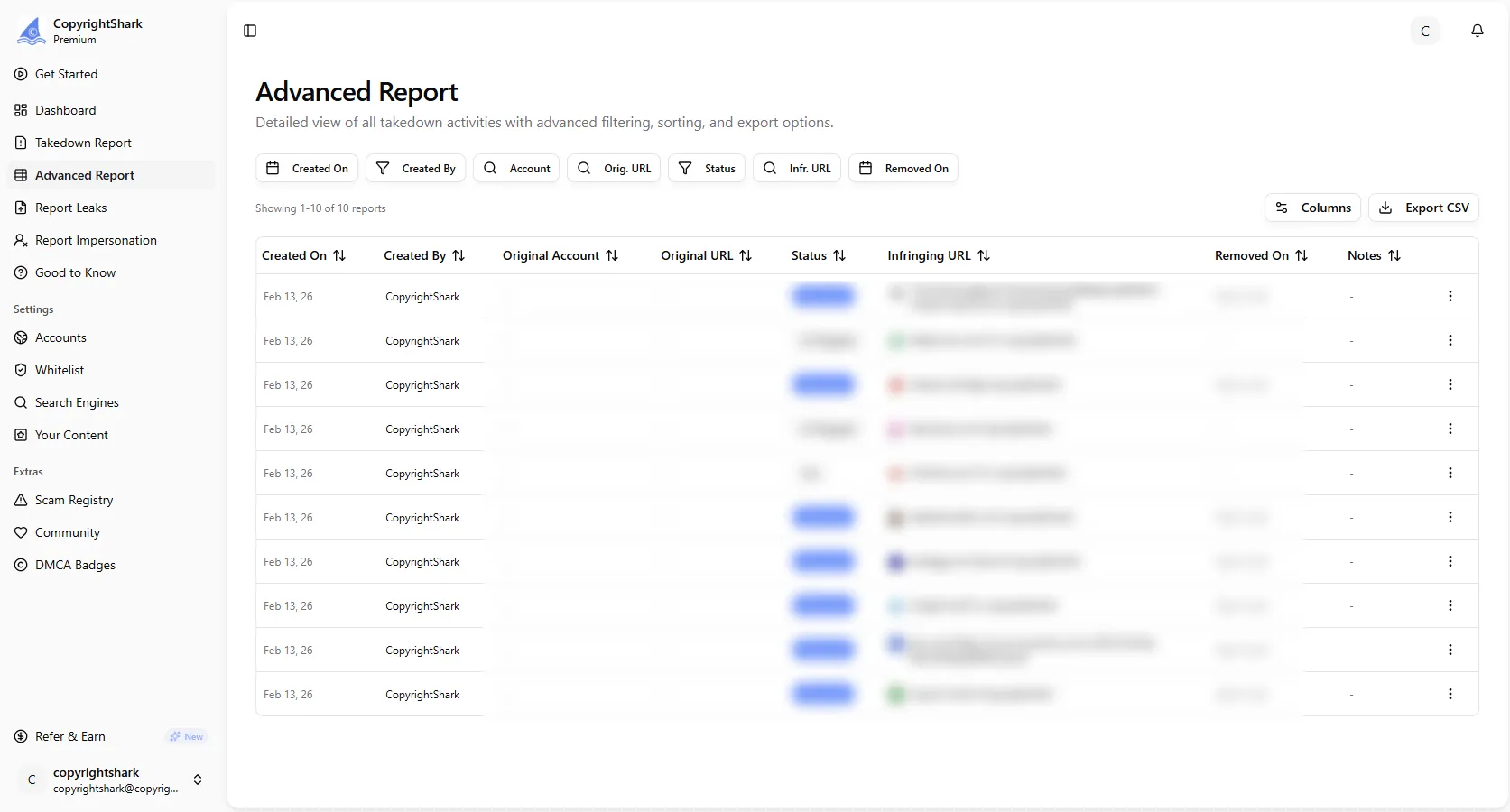
That kind of transparency is unusual in content removal. Many services send you a monthly summary email at best. CopyrightShark gives you real-time access to every action taken on your behalf.
See your removals in real time
The mirror site problem: why one-time removals fail
Most creators learn this the hard way: removing content once isn’t enough.
Leak sites operate in networks. When content gets taken down from one site, automated scrapers pick it up from caches or mirrors and re-upload it elsewhere. A popular leak forum might have three or four mirror domains. Take down the content on the main domain, and it reappears on a mirror within 48 hours.
At that point, unlimited removals stop being a pricing feature. They’re an operational necessity.
A service with removal caps forces you to choose which links to prioritize. The ones you skip get scraped and redistributed. A week later, you’re dealing with a new batch of links, and you’ve already burned through your monthly allowance on the first wave.
The only model that actually works against this is continuous monitoring paired with unlimited removal capacity. Your service scans for new instances, files takedowns as they appear, and keeps doing it without hitting a wall. That’s the model CopyrightShark uses, and it’s why the tier system controls coverage scope rather than removal volume.
For OnlyFans creators and Fansly creators, this pattern is especially common. Content from subscription platforms gets scraped and redistributed through established leak networks that specialize in exactly this cycle.
Staying anonymous during DMCA takedowns
Privacy during the takedown process is a bigger concern than most comparison articles acknowledge.
When you file a DMCA takedown notice yourself, you’re required to include your legal name, physical address, and a signature (electronic or physical). Under U.S. law (17 U.S.C. Section 512), these are mandatory elements of a valid notice.
The problem: many hosting providers and platforms forward your notice to the person who uploaded the content. Your legal name and address end up in the hands of someone who’s already demonstrated they don’t respect your boundaries. Notices also get logged in the Lumen database (formerly Chilling Effects), which is publicly searchable.
For creators who use stage names and keep their real identity private, this creates a terrible choice: protect your content and risk getting doxxed, or protect your identity and let the leaks stay up.
Third-party DMCA services solve this by filing notices as your authorized representative. CopyrightShark files using their own entity details, so your personal information never appears on the notice. You don’t need to submit government ID or proof of identity to use the service. Your reports are anonymous from start to finish.
For many creators, anonymous filing is the main reason they use a service at all. Filing takedowns yourself means exposing your identity every time.
What transparent reporting looks like
There’s a trust problem in the content removal industry. You pay a monthly fee, and… what happens? Some services send a PDF report once a month. Others send nothing and expect you to take their word for it.
Reporting should work like this:
- Every link you submit is logged with a timestamp
- You can see the current status of each link (submitted, in progress, removed, pending)
- Successful removals include confirmation details
- Failed or contested removals show why and what happens next
- You can access this information any time, not just when the service decides to send an update
CopyrightShark’s dashboard provides all of this in real time. The Advanced Takedown Report lets you filter by date range, platform category, and removal status. You’re never wondering whether your subscription is actually doing anything.
That sounds like a basic expectation. It’s not. Transparent reporting is the exception in this space.
Step-by-step: choosing the right DMCA takedown service
If you’re evaluating services right now, here’s a practical checklist. Ask these questions before you subscribe:
- How many removals are included? Get a specific number. “Unlimited” with an asterisk doesn’t count.
- Does “unlimited” mean managed removals or just DIY tools? There’s a massive difference between getting access to a template generator and having someone actually file notices on your behalf.
- Is there a per-notice fee for anything? Some services include basic removals but charge extra for search engine deindexing, legal escalation, or follow-up on rejected notices.
- Can I submit reports anonymously? If the service requires your government ID or real name on every notice, your identity is exposed.
- What does the reporting look like? Ask for a demo or screenshot of the dashboard. If they can’t show you one, that’s a red flag.
- What platforms are covered? Make sure the service covers the specific types of sites where your content appears: leak forums, tube sites, social media, messaging apps, and file-sharing platforms.
- What happens during a mass leak? Ask explicitly whether there’s a surge cap, a daily processing limit, or any throttling when volume spikes.
Red flags to watch for:
- “Unlimited” in marketing copy but caps in the terms of service
- No dashboard or reporting, just email updates
- Required personal ID for every submission
- No distinction between source removal and search engine deindexing
- Pricing that scales linearly with the number of takedowns
For the full FAQ on how CopyrightShark works, including specifics on turnaround times and platform coverage, check our help center.
Frequently asked questions
- What is the best DMCA takedown service for OnlyFans?
- The best DMCA takedown service for OnlyFans creators offers unlimited removals, anonymous filing, and covers leak forums and tube sites where OnlyFans content typically spreads. CopyrightShark meets all three criteria on every paid plan. See our OnlyFans protection page for details.
- How much does a DMCA takedown cost?
- Costs vary wildly. DMCA.com charges $199 per individual notice. Subscription services range from $24/mo to $324/mo depending on features and removal caps. CopyrightShark starts at $59.99/mo (yearly billing) with unlimited managed removals included.
- Can you file a DMCA takedown anonymously?
- Not if you file yourself. U.S. law requires your legal name and address on the notice. Services like CopyrightShark file as your authorized representative, keeping your personal details off the notice entirely.
- What happens when you hit your removal cap during a leak?
- You wait. If your plan caps at 10/day, leaked links beyond that limit stay live until the next day. Content keeps spreading while you're queued. Services with unlimited removals don't have this problem.
- Does DMCA takedown work on offshore hosting sites?
- It depends. Hosts in countries without DMCA-equivalent laws may ignore notices. Effective services combine legal notices with search engine deindexing so even if the source stays up, it loses discoverability.
- What is the difference between source removal and search engine deindexing?
- Source removal gets the actual file deleted from the hosting site. Search engine deindexing removes the URL from Google and Bing results. You typically need both: source removal stops direct access, deindexing stops discovery.
- How long does a DMCA takedown take to process?
- Most compliant hosts respond within 24-72 hours. Search engine deindexing can take 1-2 weeks through official channels. Non-compliant or offshore hosts may take longer or require escalation.
- Are unlimited DMCA services really unlimited?
- Some are, some aren't. Check whether 'unlimited' refers to managed removals or just access to DIY tools. Also check for sub-limits like per-domain URL caps or excluded platform categories. CopyrightShark's unlimited applies to actual managed removals on all paid tiers.