OnlyFans Chargebacks: Why They Happen, What They Cost You, and How to Fight Back (2026)

A new fan subscribes at 2am. Two hours later they’ve bought $340 of PPV, sent a few flirty messages, and gone quiet. Three days after that your dashboard shows a -$340 line item with a chargeback fee stacked on top. You email support. They paste a link to the Terms of Service and close the ticket.
That’s what an OnlyFans chargeback actually is. It’s not a refund the platform agreed to. It’s money pulled straight out of your earned balance for content a fan already watched. And if it happens too often, the account that gets suspended is yours, not theirs.
This guide covers what OnlyFans’ own TOS says about chargebacks (it’s not what most creators assume), what a single dispute really costs once you add up the fees and the ratio damage, the behavioral red flags that show up before most fraud cases, and the prevention playbook creators say has knocked their chargeback rate close to zero.
What is an OnlyFans chargeback (and why it’s not the same as a refund)
A chargeback isn’t a refund. A refund is something the merchant chooses to send back. A chargeback is the buyer’s bank yanking the money on its own, usually before anyone at the merchant even sees the dispute. The fan calls Visa or Mastercard, says “I don’t recognize this charge” or “I never got what I paid for,” and the transaction reverses. OnlyFans is the merchant of record, so the dispute lands in their queue. But the money comes out of your balance.
There are two flavors of chargeback creators see most often:
- Friendly fraud. The fan absolutely got the content. They watched it, screenshotted it, then told their bank they didn’t. This is the dominant pattern on adult platforms because the buyer often doesn’t want the line item on a shared statement.
- Stolen-card fraud. The card was lifted from someone else. The real cardholder disputes the charge. The fan account that bought the content gets flagged, but the creator still eats the loss.
The honest read from creators on the OnlyFans subreddit: most chargebacks aren’t buyer-protection cases. They’re people who wanted free porn, got it, and then used the dispute system as a retroactive discount.
Does OnlyFans refund chargebacks? (No, here’s what actually happens)
Short answer: no. OnlyFans does not cover chargebacks. Once the dispute resolves against the platform, the money is debited straight from the creator’s earned balance. This isn’t folklore. It’s written into the OnlyFans Terms of Service.
Here is the exact language from section 10(f) of the OnlyFans Terms of Service, under “Creator payouts”:
If a Fan successfully seeks a refund or chargeback from their credit card provider of a Fan Payment, we may deduct an amount equal to the Creator Earnings portion of the refunded or chargedback amount.
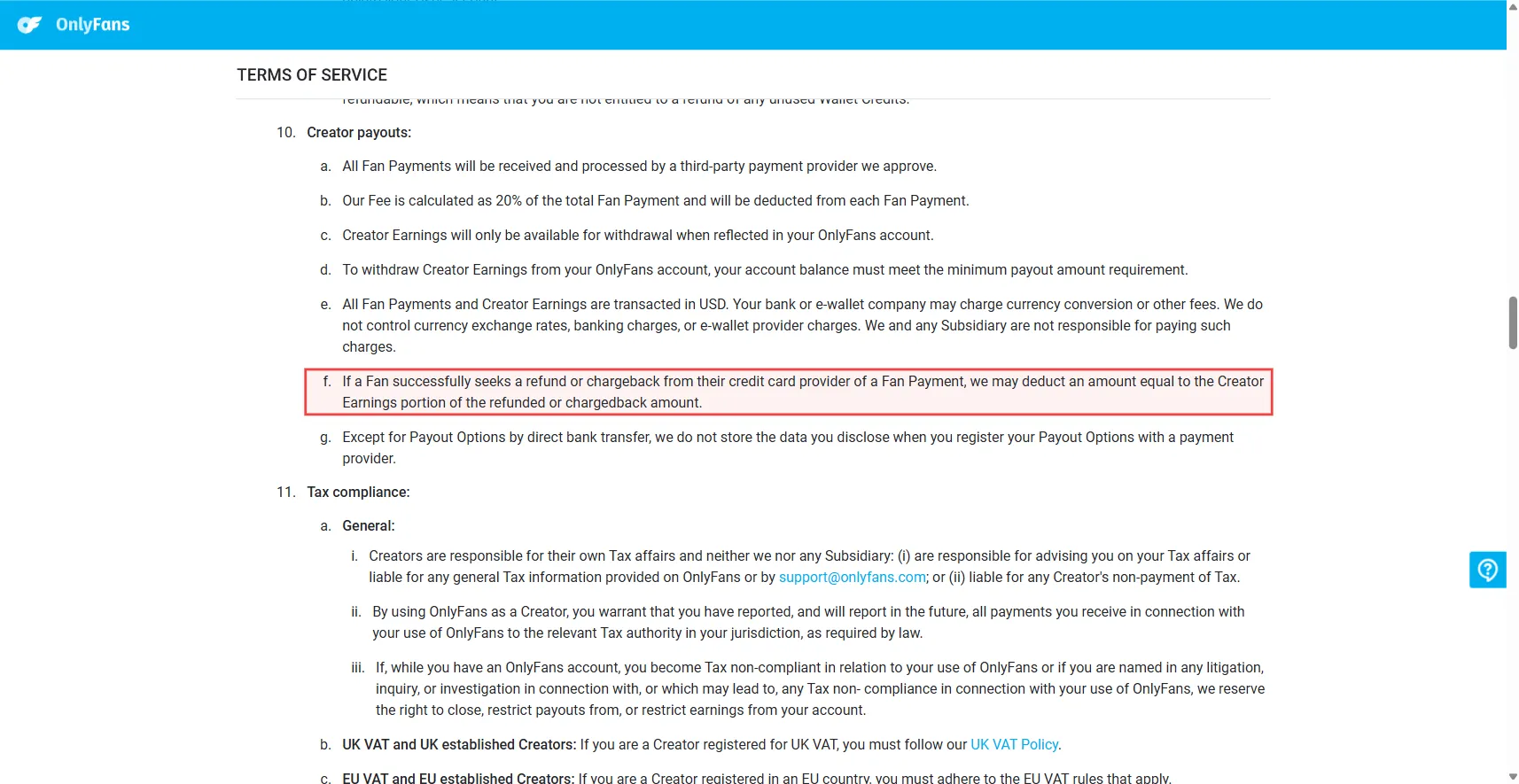
Clause 10(b) of the same section confirms the 20% platform fee: “Our Fee is calculated as 20% of the total Fan Payment and will be deducted from each Fan Payment.” Put those two clauses together and the math is ugly. You only ever received 80% of the gross. If the fan disputes, the full creator-earnings portion can be clawed back. The TOS doesn’t mention a creator protection fund, a shared liability pool, or any kind of good-faith reimbursement program. None of those exist on paper.
What this looks like in practice on a $300 PPV bundle:
| Step | What happens |
|---|---|
| 1 | Fan pays $300 for a PPV bundle. OnlyFans takes its 20% platform fee. You see roughly $240 land in your earned balance. |
| 2 | Three days later, the fan disputes the charge with their bank. |
| 3 | Bank reverses the $300. OnlyFans pulls the full $300 back off your balance, plus a chargeback handling fee. |
| 4 | You earned $240 on this transaction but lose $300+ when it reverses. You are now net-negative on a sale you fulfilled. |
That asymmetry is the part new creators rarely see coming. You earned 80% of the gross but you carry 100% of the loss. Creators on Reddit have been describing this exact dynamic for years, and the support replies they post look almost identical every time: a polite paragraph citing the TOS, followed by a closed ticket.
The rare exception: theft-of-service framing
Reversals do happen, but they’re rare and they share a pattern. Creators who recovered chargebacks describe doing all of the following before contacting support:
- Screenshotted the entire PPV transaction inside the message thread
- Exported the conversation showing the fan asking for, receiving, and reacting to the content
- Framed the support ticket as theft of service, not as a billing dispute
- Escalated past the first canned reply and asked for a supervisor
Even then the outcome is a coin flip. One creator got a $300 chargeback reversed seven days after submitting screenshots. Another submitted what sounds like identical evidence and got back “the fan account shows suspicious activity but we cannot reverse the transaction” as the final word. There’s no published criteria for which cases win.
How much does an OnlyFans chargeback actually cost you?
The headline number is only part of the bill. On a $300 PPV bundle, one chargeback costs you:
- The $300 of revenue itself, debited from your earned balance.
- A chargeback handling fee somewhere in the $15 to $25 range that processors pass through to merchants. OnlyFans doesn’t publish a creator-facing fee schedule for this, so the exact number varies, but creators describe seeing one consistently.
- A bump in your chargeback ratio, which the dashboard never shows in dollars but absolutely costs you later.
- The sunk cost of fulfillment. You already made and delivered the content. The fan kept it. You can’t resell what you already sent.
Add the time spent on a support ticket that probably won’t go your way and one fraudulent buyer can wipe out a good week.
Why too many chargebacks can suspend YOUR account
Here’s the part that blindsides creators. OnlyFans is the merchant of record with Visa and Mastercard. Your chargebacks count toward OnlyFans’ merchant-level dispute ratios, and the way OnlyFans manages that risk is by offboarding the creators pushing their numbers up.
Visa’s Dispute Monitoring Program (VDMP) flags merchants at a Standard tier of 0.9% disputes-to-sales ratio plus 100 disputes per month, with an Excessive tier at 1.8% and 1,000 disputes, plus an Early Warning level at 0.65% / 75 disputes. Mastercard runs a parallel Excessive Chargeback Program with its own cutoffs. When a high-volume merchant like OnlyFans gets near those lines, the financial pressure flows downhill, and the creators driving the ratio up lose their accounts first.
You can be a perfectly compliant creator who just happens to attract the wrong type of buyer and still lose the account. The TOS never spells this out. Nobody in support will say it out loud. It’s also why, past a certain scale, preventing chargebacks stops being optional.
The 7 red flags of a chargeback-bound subscriber
Creators who track this closely keep reporting the same pattern. Most chargebacks come from accounts hitting at least three of these signals at once:
- Brand-new account, subscribes within minutes of finding you. No history, no other creators followed, signs up and clicks subscribe in the same session.
- Buys a large PPV bundle in the first 1 to 3 hours. Not a single $10 unlock, a $200+ bundle before any conversation.
- Pushes for custom content immediately. Wants something specific, off-menu, and expensive before you’ve exchanged five messages.
- Drops affordability hints. “I shouldn’t be spending this much” or “my wife will kill me.” If they’re already worried about the money, the bank call is closer than it sounds.
- Mentions a wife, girlfriend, or shared finances. A documented pattern from creators is “if my wife sees this I’ll just say my card was hacked.” The bank call follows about 72 hours later.
- Card fails once before succeeding. Stolen-card fraud often hits a velocity check on the first try. The retry is the part the bank later disputes.
- The handle appears on creator-reported scammer registries. This is the cheapest check you can run, and it takes ten seconds.
How to prevent OnlyFans chargebacks (the creator playbook)
You can’t eliminate chargebacks entirely. But several things, stacked together, have been reported to knock the rate down hard. Use them as a combined system, not as individual tricks.
1. The welcome-message disclaimer
This is the single highest-leverage move on the list and it costs you nothing. Pin it as your auto-welcome for every new subscriber. Here’s a template you can adapt:
Hey, welcome in. Quick heads-up before we get started: all content on this page is licensed for personal viewing, not sold. That means no screenshots, no screen recording, no redistribution, and no refunds or chargebacks under any circumstances. By continuing to message me and unlock content, you’re agreeing to those terms. Content theft and fraudulent chargebacks will be reported and pursued. Now that the boring part is out of the way, tell me what brought you here.
Why does it work? Not because it gives you new legal rights. You already had those. It works because it plants the words “fraud” and “pursued” in front of someone who was casually thinking about disputing the charge later. One creator on Reddit says they’ve had zero chargebacks in the eight months since adding a disclaimer like this. Anecdotal, sure, but the same pattern shows up across the threads.
2. The 3 to 5 day “no best content” rule
Don’t send your best stuff to anyone in their first week. Build the relationship first. Send good content, just not the content that would sting the most if they bailed and disputed. If a new fan asks for something specific and expensive, note it and come back to it after day five.
3. Watermark every PPV file
Visible watermark with the buyer’s username. Two reasons. If it leaks, you can trace it. And if they dispute, the watermark proves the buyer received personalized content addressed to them, which is the kind of evidence that tips a theft-of-service ticket in your favor.
4. Screenshot every PPV transaction proactively
Don’t wait until you need evidence to go looking for it. The moment a PPV transaction clears, screenshot the thread, the unlock confirmation, and whatever reaction the fan sends. If they block you or delete their account later, the whole conversation can become unreachable. Creators have lost chargeback disputes simply because they couldn’t open the chat after the buyer vanished.
5. No sexting or customs in the first week
Custom requests are the worst chargeback bait on the platform. Buyer asks for something specific, you make it, you send it, they keep it, they dispute. And you can’t resell a custom. Save customs for fans who’ve stuck around long enough for you to know them.
6. Cap first-week PPV total per fan
Set yourself a soft limit. Something like $150 to $200 across the first seven days. If a brand-new fan wants to drop $500 in their first night, that’s not a celebration, it’s a warning. Slow it down. Tell them you’d rather pace it.
7. Run suspicious handles through a lookup tool
This is the ten-second version of due diligence. Before you fulfill anything large for a brand-new fan, paste their handle into a public scammer registry. If they show up, you just saved yourself a chargeback and the support ticket nobody wants to file.
8. Accept crypto for off-platform customs and tips
This one only applies to work you do outside the OnlyFans billing flow: direct customs, private tips, off-platform custom bundles you coordinate over Telegram or email. OnlyFans itself doesn’t take crypto, and nothing in this section changes that.
The reason creators keep bringing it up in chargeback threads is simple mechanics. A Bitcoin or stablecoin payment is irreversible at the protocol level. There is no bank to call and no dispute button. Once the transaction confirms, the money is yours. Processors like BTCPay Server, NOWPayments, and Coinbase Commerce will take the payment on your behalf and hand you a wallet address or a checkout link you can send to the buyer.
That’s the upside. The tradeoffs are real and worth naming:
- Smaller buyer pool. Most fans don’t hold crypto and won’t set up a wallet for a $40 custom. Expect this to work for a narrow slice of your audience, not all of it.
- No buyer protection cuts both ways. Irreversibility is why it stops chargebacks. It also means fans who’ve been burned by other creators are reluctant to pay upfront. You’ll need existing trust, a visible track record, or an escrow arrangement to close the sale.
- Volatility and tax reporting. If you hold the crypto instead of converting to fiat on receipt, price swings are your problem. Either way, in most jurisdictions a crypto payment is a taxable event at the fair market value on the day you received it. Keep records.
- KYC friction at cash-out. Converting to a bank deposit eventually means a KYC’d exchange, which defeats some of the privacy appeal for creators who chose crypto partly to stay off card-processor radars.
Used inside those limits, crypto is the only payment method on this list where the chargeback rate is literally zero by design. For high-risk customs from unproven buyers, which is exactly the category most likely to dispute a card charge, it’s worth offering as an option. Not a default.
Check a fan's history before you send the bundle
What to do AFTER a chargeback hits
Speed matters. The first 48 hours are when the evidence is still accessible and the support agent is still likely to actually look at it.
- Pull your evidence immediately. Screenshot the original PPV transaction, the message thread, any reactions, and the unlock confirmation. Do this before the fan account gets suspended or the buyer blocks you.
- Export the conversation. If the platform offers any export, use it. If not, screenshot the entire thread top to bottom.
- Email support and frame it as theft of service. Do not frame it as a billing dispute. Do not ask for “a refund.” Use the exact phrase “theft of service” and attach the screenshots showing delivery and reaction.
- If the first reply is canned TOS, escalate. Reply asking for a supervisor. Several creators report that the moment they mentioned escalation or their own bank, the conversation moved off the script.
- Set realistic expectations. Even with perfect evidence, the recovery rate creators report is low. It’s not zero, but it’s not the default outcome either. Treat any reversal as a bonus, not a plan.
OnlyFans vs Fansly: what the TOS actually says about chargebacks
There’s a persistent belief in creator communities that Fansly protects you from chargebacks and OnlyFans doesn’t. I went to both platforms’ current Terms of Service to check. The reality is messier, and honestly less rosy for Fansly than the Reddit threads make it sound.
Here is the relevant clause from section 3(n) “Selling Content” of the Fansly Terms of Service (last update: June 23, 2025):
Creators earn eighty percent (80%) of the revenue generated on all subscriptions, sales, or tips related to their content and User profile… However, we may deduct from such revenue any monies earned on subscriptions, sales, or tips that resulted in a chargeback, or any monies earned on subscriptions, sales, or tips related to User Content that violates these Terms.
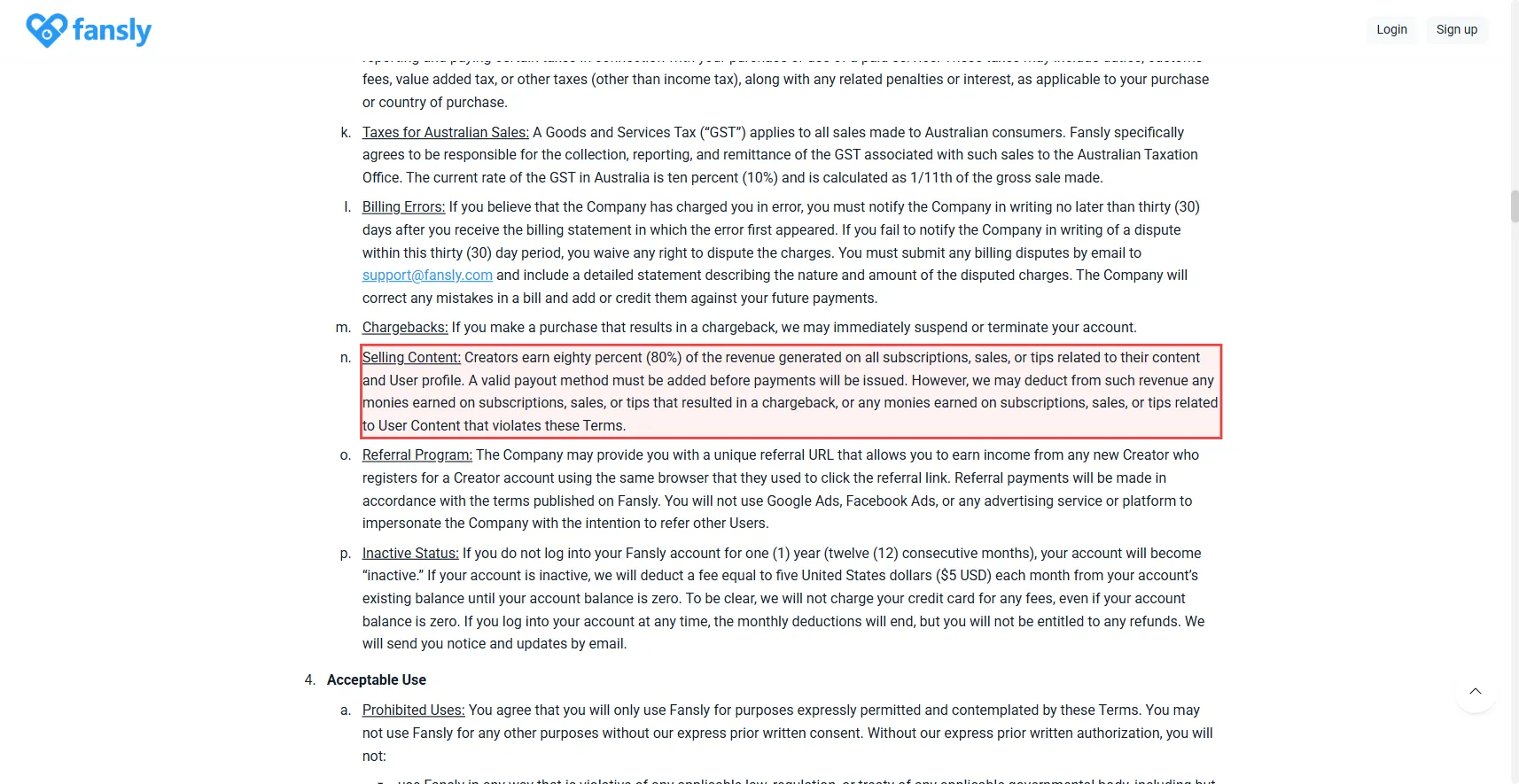
Read the two clauses side by side. Fansly and OnlyFans run the same 80/20 split, and both reserve the contractual right to deduct chargeback losses from creator earnings. The intent behind the language is almost identical.
| OnlyFans (TOS §10) | Fansly (TOS §3) | |
|---|---|---|
| Creator share | 80% (§10b) | 80% (§3n) |
| Can deduct chargeback losses from creator earnings? | Yes (§10f) | Yes (§3n) |
| Suspends fans who chargeback? | Yes (§6 “bad faith” clause) | Yes (§3m, immediate suspension or termination) |
| Dispute window for billing errors | Not specified in TOS | 30 days from statement (§3l) |
| Public chargeback fee schedule? | Not published | Not published |
So why do so many creators swear Fansly covers chargebacks when the TOS clearly says they can deduct? Two explanations, both of which might be true at once:
- Soft-enforcement gap. Fansly has the right to deduct but reportedly doesn’t always use it. Several creators say they’ve never seen a chargeback come out of their Fansly balance. That’s plausible competitive behavior for a smaller platform trying to poach creators from OnlyFans, but it’s a discretionary business choice, not a contractual protection.
- Out-of-date folklore. Some of the “Fansly absorbs chargebacks” claims go back a few years, and policies drift. The current written TOS doesn’t back the claim up.
Practical takeaway: don’t migrate your whole business to Fansly assuming chargeback protection. Treat any day Fansly chooses not to debit you as a gift, not a right. If you dual-publish, great. If you’re picking one platform solely for creator protection, this particular lever is weaker than the community thinks. For the broader content-protection picture on both platforms, see our Fansly content protection guide.
Long-term: reduce the conditions that cause chargebacks
Here’s the uncomfortable insight from creators who’ve tracked this closely: a meaningful chunk of chargebacks come from buyers who already had the content for free. They found it on a tube site or a forum, paid out of curiosity or guilt, then disputed the charge after the novelty wore off. “I already had it for free, why am I paying” is a real motive, and you can’t underwrite against it.
Which means the leak problem and the chargeback problem are actually the same problem, just one step upstream. The more aggressively you remove leaked content, the smaller the pool of buyers who can run this play on you in the first place. If your PPV isn’t sitting on a leak site, the fan who would’ve disputed it never had a reason to subscribe.
That’s what we work on at CopyrightShark: continuous monitoring and removal of leaked creator content across leak sites, search engines, and social platforms. It’s not a chargeback-prevention tool in a direct sense. It removes one of the upstream conditions that produces chargebacks in the first place. If that’s useful context for your situation, our OnlyFans content protection service covers the specifics.
Frequently Asked Questions
- Does OnlyFans refund chargebacks to fans?
- OnlyFans does not initiate refunds for chargebacks. A chargeback is initiated by the fan's bank, and once the bank reverses the charge, the platform passes the loss through to the creator whose earned balance is debited.
- How long does an OnlyFans chargeback take to appear on my dashboard?
- Most creators report chargebacks appearing 3 to 7 days after the original PPV or subscription transaction, though banks have up to 120 days under card-network rules to file a dispute. Older transactions can absolutely come back to bite you.
- Can OnlyFans ban a fan for charging back?
- Yes. Creators report OnlyFans typically suspends offending fan accounts within 24 to 48 hours of a confirmed chargeback. Both OnlyFans and Fansly also block the same payment credentials from creating a new account until the chargeback is repaid.
- What's the OnlyFans chargeback fee?
- OnlyFans does not publish a creator-facing chargeback fee schedule. The deduction creators describe seeing is consistent with the $15 to $25 range that card processors typically pass through to merchants, on top of losing the full transaction value.
- Will OnlyFans suspend my creator account for chargebacks I didn't cause?
- Yes, it can happen. OnlyFans is the merchant of record with Visa and Mastercard, so creators driving up the platform's overall dispute ratio are at risk of suspension regardless of whether the chargebacks were their fault. Visa's Dispute Monitoring Program flags merchants at 0.9% disputes-to-sales and 100 disputes per month.
- Is it worth switching to Fansly just for chargeback protection?
- Probably not on that factor alone. Fansly's current Terms of Service section 3(n) explicitly reserves the right to deduct chargeback losses from creator earnings, the same as OnlyFans section 10(f). Some creators report that Fansly rarely exercises that right in practice, but it's a discretionary business choice, not a contractual protection. Treat any day Fansly chooses not to debit you as a gift, not a right.
- Can I sue a fan who charged back after stealing my content?
- In principle, yes. In practice, you almost never know the fan's real identity, and small-claims recovery against an anonymous online buyer is impractical. Framing the OnlyFans support ticket as theft of service and pushing for a reversal is a more realistic path.
- Does a welcome-message disclaimer actually help?
- Anecdotally, yes. Creators report that adding a clear no-refunds, no-chargebacks, content-is-licensed disclaimer to their auto-welcome message materially reduced their chargeback rate, in some cases to zero over multiple months. It works as deterrence rather than as a legal shield.