GTA 6 Copyright for Streamers and YouTubers: What's Safe, What Gets Claimed, and How to Fix It

Yes, you can stream GTA 6 and post GTA 6 videos. Rockstar has let fans share gameplay of its games for years, and its video policy, which covers Grand Theft Auto VI the same way it covers every other Rockstar title, still says so. The GTA 6 copyright problems that actually hit creators are narrower and fairly predictable: licensed songs on the in-game radio, cutscenes or the ending posted on their own, and in-game TV and comedy clips posted in isolation.
This guide covers the rules that matter when you go live or hit upload: what Rockstar’s policy says word for word, which radio stations put your VODs at risk, what’s known about a streamer mode, and how Twitch, YouTube and TikTok deal with music. The second half is for when something has already landed: how to tell a claim from a strike, when a dispute or counter-notice makes sense, and when it backfires.
We send DMCA takedown notices for creators every day, so we see this process from the sender’s side. What follows is practical guidance, not legal advice.
Can I post this? The GTA 6 copyright cheat sheet
Find what’s in your video or stream, then read across. Each cell is the realistic outcome on that platform: a mute, a claim, or a removal.
| What’s in your video or stream | Twitch (live / VOD & Clips) | YouTube (long-form / Shorts) | TikTok & Reels |
|---|---|---|---|
| Gameplay with your voice or face-cam, radio off | Low / Low | Low / Low | Low |
| Licensed radio audible, in a car or on foot through in-game headphones | Medium / High: VOD segments muted, Clips deleted | High: Content ID claim / High: Shorts over 1 minute blocked while claimed | High: can be removed |
| In-game podcasts or talk radio left running* | Low to Medium | Low to Medium | Low to Medium |
| Story cutscenes inside a longer playthrough | Low: Rockstar allows it | Low / Medium: a short clip of one scene is an isolated cutscene* | Medium* |
| One cutscene, the ending, or an “all cutscenes” compilation | High: on Rockstar’s removal list | High | High |
| In-game TV shows or comedy sets posted on their own | High | High | High |
| The ending or a big plot reveal in your title or thumbnail* | Medium to High | Medium to High | Medium to High |
| The Justice score or GTA VI: The Album tracks audible* | Medium | Medium, likely higher once the score album is out | Medium |
| Cheats, money glitches, mod menus or unauthorized mods | High | High | High |
| A Rockstar trailer inside a reaction with real commentary | Medium: the trailer music can match | Medium | Medium |
| A Rockstar trailer reuploaded with little or no commentary | High | High | High |
| A watch-along of another streamer’s GTA 6 stream | Medium: their content, plus any radio in it | Medium | Medium |
“Risk” here means how likely a mute, claim or removal is, not legal liability. These ratings are our reasoning from Rockstar’s policy, each platform’s published rules and how audio matching works. They are not measured data. Rows marked * are our own reading where no official rule exists yet.
What Rockstar’s GTA 6 video policy actually says
There is no GTA VI-specific video policy as of November 17, 2026. The Rockstar video policy that applies is its all-titles support article, “Policy on posting copyrighted Rockstar Games material,” last updated January 10, 2025.
The core sentence is generous:
“Generally, Take-Two Interactive does not object to our fans using materials for non-commercial uses in a manner which does not intentionally spoil the plot for others.”
The very next line defines the catch: “‘Non-commercial’ means that you don’t make money through the game footage you post or use the material as part of a promotion for a product or service. Take-Two Interactive reserves the right to have its copyrighted material taken down at any time.”
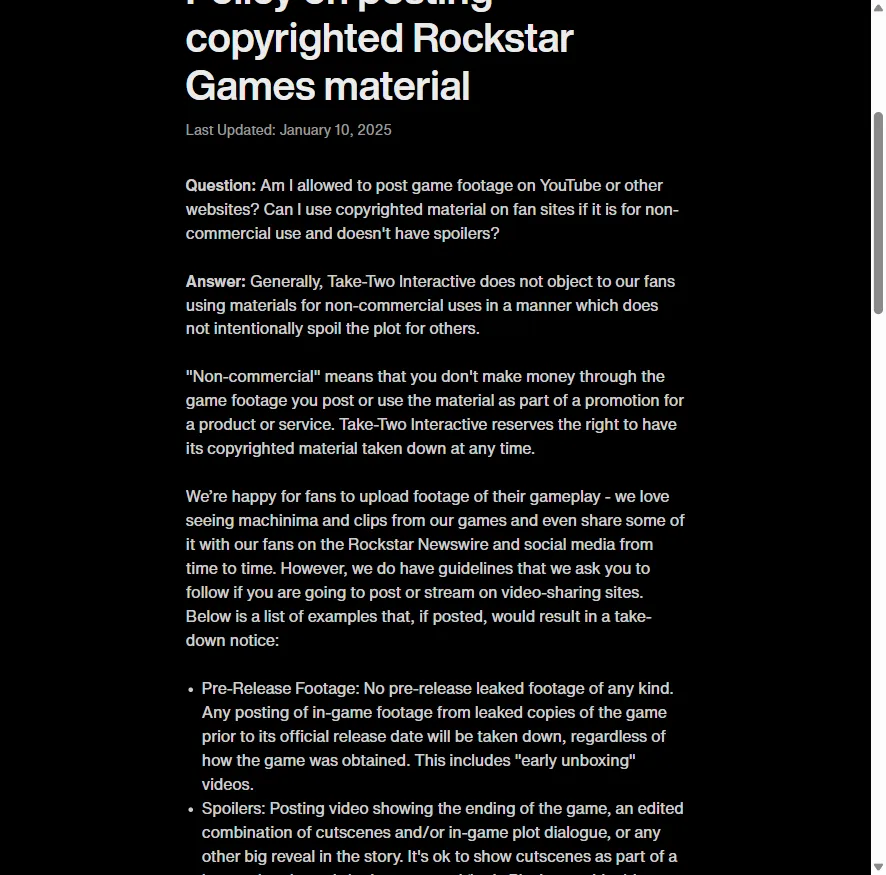
The policy then lists examples that “would result in a take-down notice”:
- Spoilers: “Posting video showing the ending of the game, an edited combination of cutscenes and/or in-game plot dialogue, or any other big reveal in the story.”
- In-game entertainment: TV shows and comedy performances. “Any posting of these in isolation will be flagged for removal.”
- Encouraging cheating: money or RP glitches, duplication, selling accounts, “God Mode” exploits and third-party mod menus.
- Promoting modifications or ports: “distributing or promoting unauthorized mods or ports that violate Rockstar’s rights.”
The list also bans footage from copies obtained before the official release date. That window closes when the game launches on November 19.
Two details are easy to miss. If you’re unsure whether a scene counts as a spoiler, Rockstar asks you to email [email protected] and “describe exactly what scene you are wondering about and in what context the scene would appear.” And the policy only covers “occasional, non-commercial in-game content use by individual members of the Rockstar fan community.” It says it does not apply to “film, TV, or streaming distribution” deals, music videos or ads. Your Twitch channel isn’t what that line is about.
Notice what’s missing: the policy says nothing about music. That matters more than anything else on this page.
Can you monetize GTA 6 videos and streams?
Read literally, the policy says no. Making money “through the game footage you post” is the exact thing it calls commercial.
In practice, monetized GTA V channels and partnered Twitch streams have been common for over a decade, and Take-Two hasn’t pulled them down as a group. Our read is that an ordinary monetized Let’s Play or stream with your own commentary is unlikely to be targeted by Take-Two. But tolerance is not a license. The policy keeps the right to take content down “at any time,” and a channel built mostly on isolated cutscenes or TV clips is the kind most exposed to that.
Two other money problems have nothing to do with Rockstar:
- Music claims take your revenue. On YouTube, a Content ID claim can monetize your video for the claimant. YouTube says “Monetize” is the most common policy on music claims. One radio song in a long video can send that video’s ad money to a label.
- Violence can limit reach. YouTube’s violent content policy says it may age-restrict dramatized violence with graphic scenes, and it names videos that focus “solely on the most graphically violent part of a film or video game” as a factor. A “most brutal moments” compilation is a worse bet than a normal playthrough.
The radio is the real GTA 6 music copyright risk
The songs on GTA 6’s radio are licensed to Rockstar for use in the game. That license doesn’t extend to you broadcasting them on Twitch or uploading them to YouTube, and Rockstar can’t hand you rights it doesn’t hold. So when a GTA 6 video gets a music claim, it almost always comes from the label, publisher or distributor that owns the song, not from Rockstar.
Twitch’s Music Guidelines (last modified July 31, 2023) are blunt: “you should only include music in your Twitch channel if you’re sure you have the necessary rights or authority to do so.” There is no exception for music inside video games. Twitch also notes that buying music “typically does not grant you rights to share that music on Twitch.” Owning a copy of the game works the same way. It lets you play, not rebroadcast the soundtrack.
Enforcement is partly automatic. Twitch says: “We may mute VODs and delete Clips where our audio recognition system detects copyrighted audio in them.” On YouTube, Content ID compares your upload against reference files from rights holders and applies whatever policy the owner chose.
GTA 6 adds a twist. According to Rockstar, radio and podcasts play “in vehicles and on foot through newly introduced headphones and earbuds connected to their smartphones.” In older games, getting out of the car meant silence. In this one, licensed music can follow your character down the street.
Until the in-game audio settings can be checked after launch, the safe habit is simple: radio and headphones off whenever you’re live or recording something you plan to post.
GTA 6 radio stations and how risky each is on stream
Rockstar’s October 8, 2026 Newswire post named six stations. It said the full lineup spans “everything from Classic Rock to Talk Radio” and introduced on-demand podcasts, but it didn’t name those other stations.
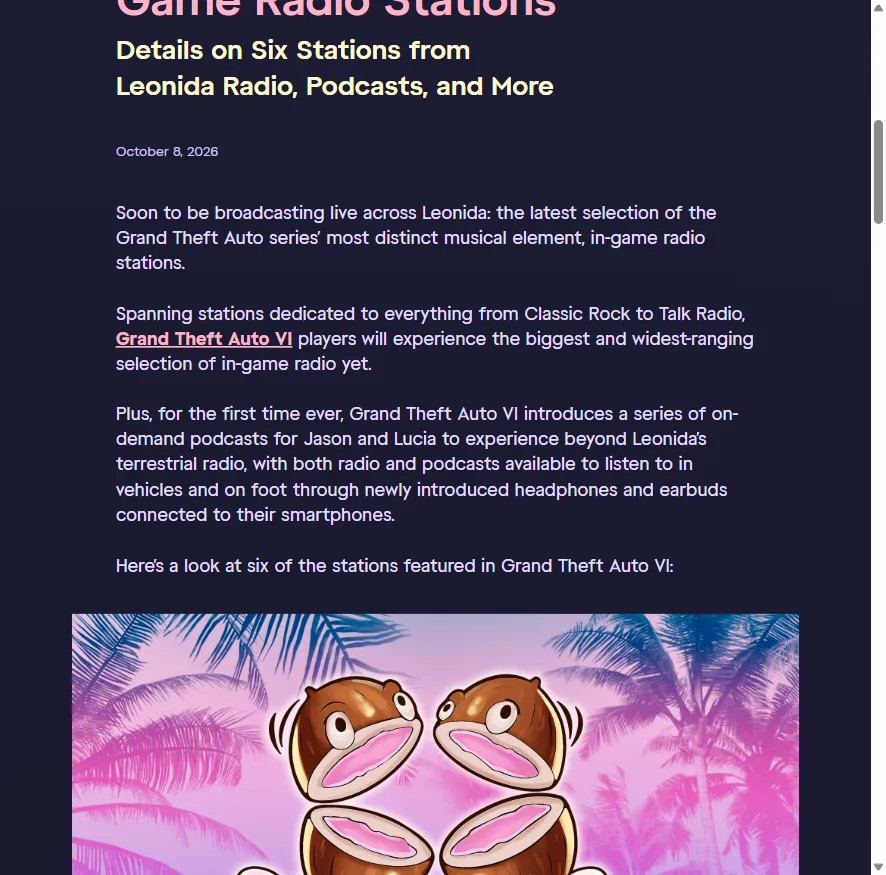
| Station | What Rockstar says it plays | Stream risk (our reasoning) |
|---|---|---|
| Cocoteo FM | Modern Latin: bachata, merengue, dembow, reggaeton | High |
| Back Country Radio | Renegade country | High |
| AfroBank FM | African music, from 20th-century classics to amapiano and 3-step | High |
| The Chamber 106.6 | Metal, “decades of timeless metal anthems” | High |
| Flash FM | Pop | High |
| Dirty South Classics | Regional rap and hip-hop classics | High |
| Classic rock station (not yet named) | Classic rock | High |
| Talk radio station (not yet named) | Talk | Low to Medium |
| On-demand podcasts | Spoken-word shows, in vehicles and on foot | Low to Medium |
Why every music station is rated High: each one plays commercially released recordings owned by labels and publishers. Whether a specific song gets matched depends on whether its owner registered it with Content ID or Twitch’s audio recognition, and which policy they picked. You can’t see that from inside the game, so the only workable assumption is that any song can match. This is our reasoning, not measured data.
Talk radio and podcasts are rated lower because they’re spoken-word shows rather than label recordings, which are what music matching is mostly built around. They’re still copyrighted, and Rockstar’s own policy treats in-game entertainment posted on its own as a removal trigger.
As of November 17, 2026, Rockstar hasn’t published official tracklists, so we don’t list songs here. You can hear previews of the six named stations in the music section of the official GTA VI site.
GTA 6 streamer mode: what’s confirmed as of November 17, 2026
Even if a streamer mode exists, it would fix less than people hope:
- It could remove the biggest source of claims. If it swaps or mutes licensed radio, most music claims go away.
- “Original” music isn’t automatically safe. Rockstar’s October 29 post says the Justice score comes out as a 30-track album on streaming services, CD and vinyl on December 11, and GTA VI: The Album has 34 original tracks. Commercially released recordings can be registered for matching like any other song. A mode that keeps the score playing may still leave you open to claims on it. We’d call that likely, not certain.
- It does nothing about spoilers. Cutscene, ending and in-game TV removals come from Rockstar’s policy, not from music matching.
- It doesn’t stop manual notices. A rights holder who watches your video can still file a takedown by hand.
Spoilers, cutscenes and in-game TV: the removal triggers
Rockstar draws the cutscene line in one sentence: “It’s ok to show cutscenes as part of a larger play-through (or in a narrated ‘Let’s Play’ type video) but isolated videos of the game’s cinematics will be removed.”
In practice:
- Fine: full or long playthroughs where cutscenes play as they come, with or without commentary.
- Removed: a single cutscene uploaded alone, the ending, “every cutscene” movie edits, and compilations of plot dialogue.
- Short-form trap: a 45-second Short or TikTok of a story scene is, by Rockstar’s own definition, an isolated cinematic. Clip gameplay moments, not story moments.
- Titles and thumbnails: the policy targets videos that show “any other big reveal in the story.” A thumbnail that gives away the reveal invites reports, and probably annoys your viewers too. Keep it vague.
- In-game TV and comedy: fine in passing during gameplay, flagged when posted on their own. Podcasts aren’t named in the policy, but we’d expect a full episode posted alone to be treated the same way (our reading).
If you’re unsure about a specific scene, email [email protected] with the scene and the context you plan to post it in, as the policy asks.
Twitch, YouTube and TikTok enforce copyright differently
Twitch
Twitch has three separate tracks, and they don’t work the same way:
- Audio recognition mutes VOD segments and deletes Clips. Twitch’s guidelines don’t describe this as a strike.
- The Music Reporting Process covers rights holders who have agreements with Twitch. For “certain egregious uses,” Twitch issues “a warning to creators for their first offense, and issue[s] penalties for subsequent offenses,” and it may suspend livestreams or delete recorded videos.
- DMCA notices lead to copyright strikes. Under Twitch’s DMCA Guidelines (last modified October 11, 2023), you accrue a strike when Twitch gets a complete notice and no counter-notification or retraction. Three strikes makes you a “repeat infringer,” and Twitch terminates the account. If you’re invited to Copyright School and complete it, one strike is removed, once every 12 months.
YouTube
YouTube keeps claims and strikes apart, and its help pages say so directly.
A Content ID claim is automatic. Depending on the owner’s settings it can block the video, monetize it, or track its views, and the result can differ by country. Shorts between one and three minutes long are blocked while any claim is active, whatever the owner’s policy. Claims “typically” don’t lead to strikes.
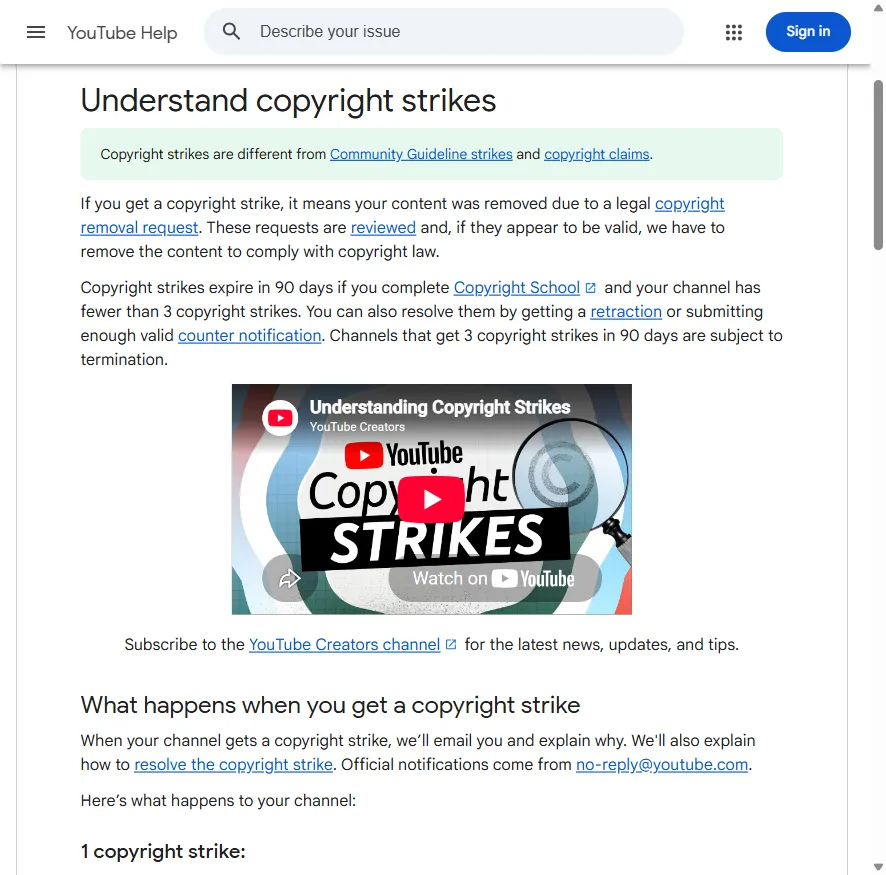
A copyright strike means your content was removed after a legal removal request. Channels with three strikes in 90 days are subject to termination. A strike expires after 90 days if you complete Copyright School. If an active live stream is removed for copyright, you also lose live streaming for 7 days, or 14 days after another strike.
TikTok and other short-form apps
TikTok’s copyright policy says “any user content that infringes another person’s copyright may be removed,” and it runs a repeat infringer policy with the option to “immediately ban any account in cases of severe copyright violations.” A short clip with a radio song running underneath is about the worst combination for any short-form app. If you want music, use a sound from the app’s own library instead of the game’s radio.
Claim, mute or strike? Identify your GTA 6 copyright problem
Before you do anything, work out which of these you actually have. The fix is different for each.
| What hit you | Who sends it | What happens | Counts toward a ban? | Usual fix |
|---|---|---|---|---|
| YouTube Content ID claim | An automated match from the rights holder (for radio, usually a label, publisher or distributor) | Video blocked, monetized for the claimant, or tracked, possibly by country | No, unless you dispute without a valid reason and the owner escalates | Trim or mute the song, or leave the claim |
| Twitch muted VOD or deleted Clip | Twitch’s audio recognition | Muted VOD segments, deleted Clips | Not a strike on its own | Accept it; appeal only if you hold the rights |
| Twitch Music Reporting Process | Music rights holders with a Twitch agreement | First-offense warning, then penalties; streams can be suspended | Yes, its own penalty track | Stop playing the music |
| Copyright strike (DMCA takedown) | The rights holder or its agent: a label or publisher for music, Take-Two for game content | Video or VOD removed | Yes: 3 on Twitch, or 3 in 90 days on YouTube | Retraction, Copyright School, or a counter-notice if it was a mistake |
| Platform policy action (age restriction, limited ads) | The platform itself | Less reach or less ad money | Not a copyright strike | Edit or appeal under that policy |
Fix a GTA 6 copyright claim or strike without making it worse
- Identify what you have. Use the table above. YouTube Studio shows claims under Content, filtered by Claims or Copyright. Twitch shows DMCA notices in your Copyright Claims Manager.
- For a music claim on YouTube, edit or accept. YouTube lets you leave the claim, remove the claimed content, or dispute. Removing the song with the Studio editor is usually the cleanest fix. Dispute only if you have a real basis, because YouTube warns that disputing “without a valid reason” lets the owner file a removal request, which can mean a strike.
- For a muted Twitch VOD, mostly let it go. The appeal process (linked from Twitch’s Music Guidelines) is for people who hold the rights to the audio. Next time, cut the radio before you export highlights.
- For a GTA 6 copyright strike, use the quiet options first. On YouTube, complete Copyright School and wait 90 days. On either platform, you can contact whoever sent the removal request (the strike details name them) and ask for a retraction. YouTube also says that if a removal request was “scheduled,” you get 7 days to delete the video and avoid the strike.
- File a counter-notice only for a genuine mistake. Wrong video, content you own, or a fair use case you could defend in court. Our free DMCA counter-notice template covers the required parts.
Fair use is a defense, not a filter
Commentary, criticism, review and reaction can be fair use under US law. Courts weigh four factors: the purpose of your use, the nature of the work, how much you used, and the effect on the market for the original. Twitch’s own Music Guidelines say not every unauthorized use is infringing and point to fair use.
But fair use is something you argue after the fact. Content ID and Twitch’s audio recognition don’t check for it. They match audio and apply a rule. Fair use only enters the picture at the dispute or counter-notice stage.
And be honest about what you’re commenting on. Talking over a mission while a pop song plays on the car radio is commentary on the game, not on the song. That’s a weak fair use argument for the song. If terms like “repeat infringer” or “counter-notification” are new, our DMCA glossary explains them in plain English.
When clip channels reupload your GTA 6 streams
There’s a flip side to all this. Your commentary, face-cam, edits and overlays are your own copyrighted work, layered on top of Rockstar’s footage. When a clip channel lifts your best GTA 6 moments and posts them as its own, you can file a takedown for the parts you made.
Clip channels follow whatever is trending, and GTA 6 will be trending for a while. To get reuploads removed:
- File through the platform’s copyright form, or send a DMCA notice. Our DMCA takedown notice template builds one in a couple of minutes.
- Describe your own contribution. Name your voice, face-cam and edit as the infringed work. Don’t claim Rockstar’s footage as yours.
- Use the platform-specific route. For TikTok reposts, see our guide to reporting TikTok copyright infringement. For Shorts and Reels copies, our short-form video protection guide covers the forms.
- Leave real commentary alone. Someone reacting to your clip with their own take may have a fair use argument of their own. Wholesale reuploads are the ones worth filing on.
Clips of your stream reposted without permission? We find and remove them.
Frequently asked questions
- Can you stream GTA 6 on Twitch without getting muted?
- Yes, if you keep licensed music out of the stream. Twitch's audio recognition mutes VOD segments and deletes Clips when it detects copyrighted songs, so turn off the car radio and the in-game headphones while you're live. Gameplay and your own commentary aren't the problem.
- Does GTA 6 have a streamer mode?
- As of November 17, 2026, Rockstar has not announced one. Its official posts about the radio, the score and pre-loading don't mention a streamer mode or a music-muting option. Reports that it exists come from social media. We'll update this answer after launch.
- Is GTA 6 music copyrighted?
- Yes. The radio plays commercially released songs owned by labels and publishers, licensed to Rockstar for the game, not to you for streaming or uploads. Those owners, not Rockstar, send most music claims. None of the radio stations should be treated as copyright-free.
- Is the GTA 6 original score by Justice safe to use in videos?
- Not automatically. Rockstar says the score comes out as a 30-track album on streaming services on December 11. Commercially released recordings can be registered for audio matching, so claims on the score are likely once it's out, even if it's composed for the game.
- Can I monetize GTA 6 videos on YouTube?
- Rockstar's policy says fan use should be non-commercial, but monetized Let's Plays of its games have been tolerated for years. Tolerance isn't a license. Separately, any radio song in your video can trigger a Content ID claim that sends the ad revenue to the music owner.
- Will Rockstar copyright-strike my GTA 6 video?
- Not for normal gameplay with commentary. Rockstar's policy lists what gets taken down: spoilers like isolated cutscenes and the ending, in-game TV and comedy posted alone, cheating guides, and unauthorized mods. Most strikes on GTA videos come from music owners, not Take-Two.
- Can I post GTA 6 cutscenes or the ending?
- Cutscenes are fine inside a larger playthrough or narrated Let's Play. Isolated cutscenes, the ending, and edited compilations of cutscenes or plot dialogue get removed under Rockstar's policy. Keep big reveals out of titles and thumbnails as well.
- Can I use the official GTA 6 trailers in a reaction video?
- A reaction with real commentary is a reasonable fair use case, but Content ID still matches the music. The launch trailer uses Flower in a Hurricane from the Justice score album. Reuploading a trailer with little or no commentary is the risky version.
- Does Twitch mute GTA 6 VODs?
- Twitch mutes VOD segments when its audio recognition detects copyrighted audio, which in GTA 6 mostly means the licensed radio. Muting isn't a strike by itself. DMCA notices from rights holders are a separate track that does lead to strikes.
- How long does a YouTube copyright strike last?
- A YouTube copyright strike expires after 90 days if you complete Copyright School. You can also clear it with a retraction from the claimant or a valid counter-notice. Three strikes within 90 days can get the channel terminated. See our counter-notice template for genuine mistakes.